Advertisements
Advertisements
Question
Diagonals of a quadrilateral are perpendicular to each other. Is such a quadrilateral always a rhombus? Give a figure to justify your answer.
Advertisements
Solution
It is not necessary that a quadrilateral having perpendicular diagonals is a rhombus.
E.g. Consider a trapezium ABCD in which AB || CD.
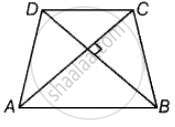
APPEARS IN
RELATED QUESTIONS
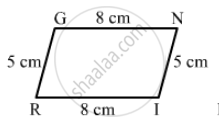
Can the following figure be parallelogram. Justify your answer.
If an angle of a parallelogram is two-third of its adjacent angle, find the angles of the parallelogram.
Two adjacent sides of a parallelogram are 4 cm and 3 cm respectively. Find its perimeter.
Which of the following statement is true for a rhombus?
It has only two pairs of equal sides.
Fill in the blank, in each of the following, so as to make the statement true:
If the diagonals of a parallelogram bisect each other at right angles, then it is a ......
ABCD is a rhombus and its diagonals intersect at O.
(i) Is ∆BOC ≅ ∆DOC? State the congruence condition used?
(ii) Also state, if ∠BCO = ∠DCO.
The diagonals of a quadrilateral are of lengths 6 cm and 8 cm. If the diagonals bisect each other at right angles, what is the length of each side of the quadrilateral?
Identify all the quadrilateral that have Four sides of equal length
A quadrilateral whose all sides are equal, opposite angles are equal and the diagonals bisect each other at right angles is a ______.
Construct a rhombus CLUE in which CL = 7.5 cm and LE = 6 cm.
