Advertisements
Advertisements
Question
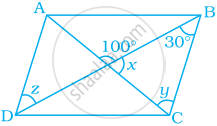
ABCD is a parallelogram. Find the value of x, y and z.
Advertisements
Solution
Given, A parallelogram ABCD.
In the ΔOBC, we have
y + 30° = 100° ...[Exterior angle property of triangle]
⇒ y = 70°
By the angle sum property of a triangle,
We have, x + y + 30° = 180°
⇒ x + 70° + 30° = 180°
⇒ x = 180° – 100°
⇒ x = 80°
Now, since AD || BC and BD is transversal,
Therefore, ∠ADO = ∠OBC ...[Alternative interior angles]
⇒ z = 30°
APPEARS IN
RELATED QUESTIONS
Can a quadrilateral ABCD be a parallelogram if ∠D + ∠B = 180°?
Can a quadrilateral ABCD be a parallelogram if AB = DC = 8 cm, AD = 4 cm and BC = 4.4 cm?
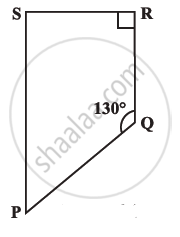
Find the measure of ∠P and ∠S, if `bar(SP) || bar(RQ)` in the following figure. (If you find m∠R, is there more than one method to find m∠P?).
ABCD is a parallelogram. What kind of quadrilateral is it if: AC = BD but AC is not perpendicular to BD?
The given figure shows parallelogram ABCD. Points M and N lie in diagonal BD such that DM = BN.
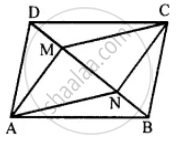
Prove that:
(i) ∆DMC = ∆BNA and so CM = AN
(ii) ∆AMD = ∆CNB and so AM CN
(iii) ANCM is a parallelogram.
Iron rods a, b, c, d, e, and f are making a design in a bridge as shown in the figure. If a || b, c || d, e || f, find the marked angles between d and f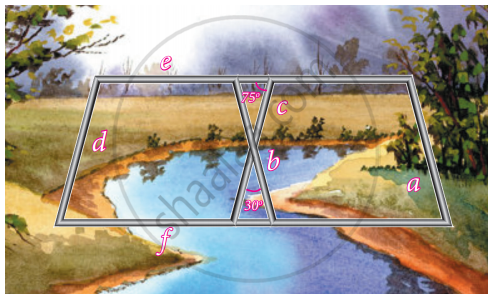
Two angles of a quadrilateral are each of measure 75° and the other two angles are equal. What is the measure of these two angles? Name the possible figures so formed.
In parallelogram ABCD, the angle bisector of ∠A bisects BC. Will angle bisector of B also bisect AD? Give reason.
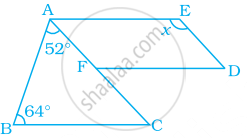
In the following figure, FD || BC || AE and AC || ED. Find the value of x.
Draw a rough figure of a quadrilateral that is not a parallelogram but has exactly two opposite angles of equal measure.
