Advertisements
Advertisements
Question
A diagonal of a parallelogram bisects an angle. Will it also bisect the other angle? Give reason.
Advertisements
Solution
Let ABCD is a parallelogram.
Given: ∠1 = ∠2
Now, ABCD is a parallelogram.
So, ∠1 = ∠4 [Alternate angles] ...(i)
Also, ∠2 = ∠3 [Alternate angles] ...(ii)
Now, ∠1 = ∠2 ...[Given]
Hence, ∠3 = ∠4 ...[From equation (i) and (ii)]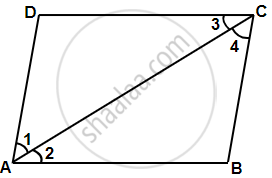
APPEARS IN
RELATED QUESTIONS
Can a quadrilateral ABCD be a parallelogram if AB = DC = 8 cm, AD = 4 cm and BC = 4.4 cm?
Construct ☐ BARC such that l(BA) = l(BC) = 4.2 cm, l(AC) = 6.0 cm, l(AR) = l(CR) = 5.6 cm
In parallelogram PQRS, ∠Q = (4x – 5)° and ∠S = (3x + 10)°. Calculate: ∠Q and ∠R.
In parallelogram ABCD, X and Y are midpoints of opposite sides AB and DC respectively. Prove that:
(i) AX = YC
(ii) AX is parallel to YC
(iii) AXCY is a parallelogram.
Which of the following is a property of a parallelogram?
If two adjacent angles of a parallelogram are (5x – 5)° and (10x + 35)°, then the ratio of these angles is ______.
The adjacent sides of a parallelogram are 5 cm and 9 cm. Its perimeter is ______.
If opposite angles of a quadrilateral are equal, it must be a parallelogram.
Construct a parallelogram ABCD in which AB = 4 cm, BC = 5 cm and ∠B = 60°.
Construct a parallelogram HOME with HO = 6 cm, HE = 4 cm and OE = 3 cm.
