Advertisements
Advertisements
प्रश्न
A diagonal of a parallelogram bisects an angle. Will it also bisect the other angle? Give reason.
Advertisements
उत्तर
Let ABCD is a parallelogram.
Given: ∠1 = ∠2
Now, ABCD is a parallelogram.
So, ∠1 = ∠4 [Alternate angles] ...(i)
Also, ∠2 = ∠3 [Alternate angles] ...(ii)
Now, ∠1 = ∠2 ...[Given]
Hence, ∠3 = ∠4 ...[From equation (i) and (ii)]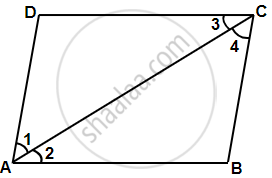
APPEARS IN
संबंधित प्रश्न
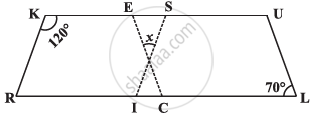
In the above figure both RISK and CLUE are parallelograms. Find the value of x.
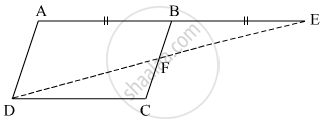
In the given figure, `square`ABCD is a parallelogram. Point E is on the ray AB such that BE = AB then prove that line ED bisects seg BC at point F.
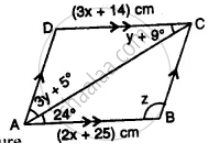
Use the information given in the alongside diagram to find the value of x, y, and z.
Iron rods a, b, c, d, e, and f are making a design in a bridge as shown in the figure. If a || b, c || d, e || f, find the marked angles between b and c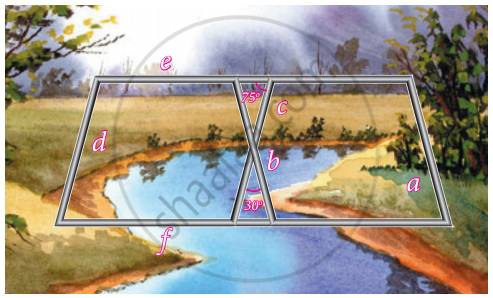
Iron rods a, b, c, d, e, and f are making a design in a bridge as shown in the figure. If a || b, c || d, e || f, find the marked angles between d and e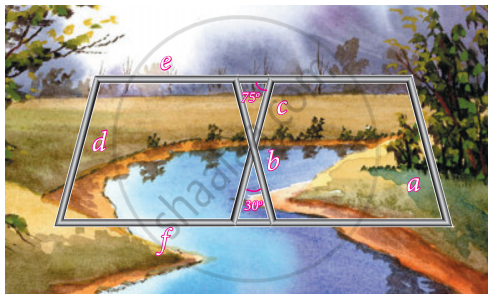
All rectangles are parallelograms.
If opposite angles of a quadrilateral are equal, it must be a parallelogram.
ABCD is a parallelogram. The bisector of angle A intersects CD at X and bisector of angle C intersects AB at Y. Is AXCY a parallelogram? Give reason.
Construct a parallelogram ABCD in which AB = 4 cm, BC = 5 cm and ∠B = 60°.
Construct a parallelogram HOME with HO = 6 cm, HE = 4 cm and OE = 3 cm.
