Advertisements
Advertisements
प्रश्न
If opposite angles of a quadrilateral are equal, it must be a parallelogram.
विकल्प
True
False
Advertisements
उत्तर
This statement is True.
Explanation:
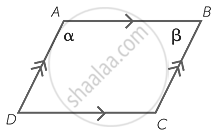
⇒ Let ABCD be a parallelogram, with A = α and B = β.
We have to prove that C = α and D = β.
⇒ α + β = 180° (co-interior angles, AD || BC),
⇒ ∠C = α (co-interior angles, AB || DC)
⇒ ∠D = β (co-interior angles, AB || DC).
APPEARS IN
संबंधित प्रश्न
In parallelogram ABCD, ∠A = 3 times ∠B. Find all the angles of the parallelogram. In the same parallelogram, if AB = 5x – 7 and CD = 3x +1 ; find the length of CD.
ABCD is a parallelogram. What kind of quadrilateral is it if: AC = BD but AC is not perpendicular to BD?
Prove that the diagonals of a parallelogram bisect each other.
Iron rods a, b, c, d, e, and f are making a design in a bridge as shown in the figure. If a || b, c || d, e || f, find the marked angles between d and f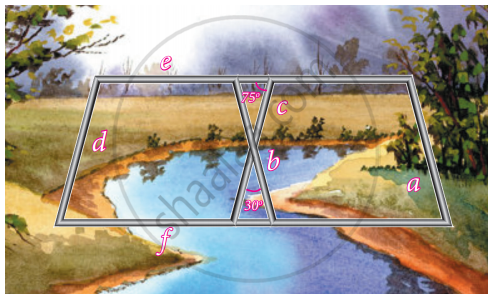
All rectangles are parallelograms.
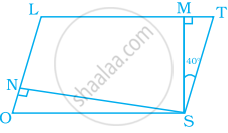
In parallelogram LOST, SN ⊥ OL and SM ⊥ LT. Find ∠STM, ∠SON and ∠NSM.
Two angles of a quadrilateral are each of measure 75° and the other two angles are equal. What is the measure of these two angles? Name the possible figures so formed.
In parallelogram ABCD, the angle bisector of ∠A bisects BC. Will angle bisector of B also bisect AD? Give reason.
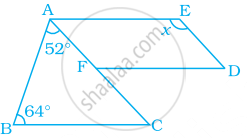
In the following figure, FD || BC || AE and AC || ED. Find the value of x.
Construct a parallelogram when one of its side is 4 cm and its two diagonals are 5.6 cm and 7 cm. Measure the other side.
