Advertisements
Advertisements
प्रश्न
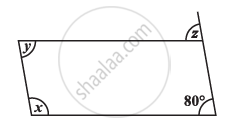
Consider the given parallelograms. Find the values of the unknowns x, y, z.
Advertisements
उत्तर
Since x + 80° = 180° ...[Sum of adjacent angles is 180°]
x = 180° − 80° = 100°
Also 80° = y ...[∵ Opposite angles are equal in a parallelogram]
And x = 180° − z ⇒ 100° = 180° − z
⇒ z = 180° − 100° = 80°
Thus x = 100°, y = 80° and z = 80°
संबंधित प्रश्न
Consider the given parallelogram. Find the values of the unknowns x, y, z.
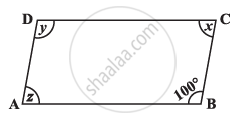
Consider the given parallelograms. Find the values of the unknowns x, y, z.
In the given figure, `square`PQRS and `square`ABCR are two parallelograms. If ∠P = 110° then find the measures of all angles of `square`ABCR.

In the adjacent figure, if seg AB || seg PQ, seg AB ≅ seg PQ, seg AC || seg PR, seg AC ≅ seg PR then prove that, seg BC || seg QR and seg BC ≅ seg QR.
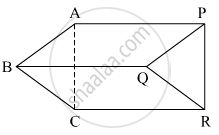
Construct ☐ BARC such that l(BA) = l(BC) = 4.2 cm, l(AC) = 6.0 cm, l(AR) = l(CR) = 5.6 cm
In the following diagram, the bisectors of interior angles of the parallelogram PQRS enclose a quadrilateral ABCD.
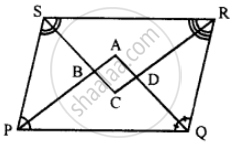
Show that:
(i) ∠PSB + ∠SPB = 90°
(ii) ∠PBS = 90°
(iii) ∠ABC = 90°
(iv) ∠ADC = 90°
(v) ∠A = 90°
(vi) ABCD is a rectangle
Thus, the bisectors of the angles of a parallelogram enclose a rectangle.
Iron rods a, b, c, d, e, and f are making a design in a bridge as shown in the figure. If a || b, c || d, e || f, find the marked angles between d and f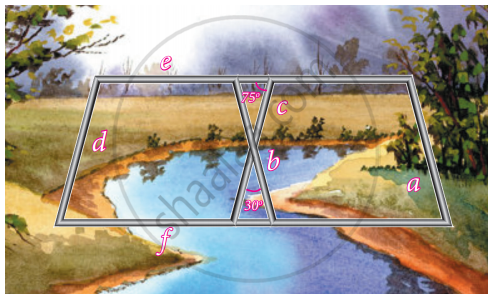
All rectangles are parallelograms.
In the following figure of a ship, ABDH and CEFG are two parallelograms. Find the value of x.
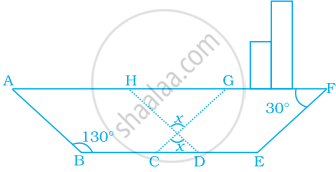
In the following figure, FD || BC || AE and AC || ED. Find the value of x.