Advertisements
Advertisements
प्रश्न
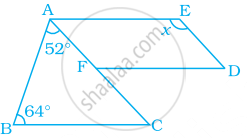
In the following figure, FD || BC || AE and AC || ED. Find the value of x.
Advertisements
उत्तर
Given: FD || BC || AE and AC || ED.
Construction: Produce DF such that it intersect AB at G.
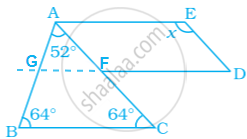
In triangle ABC,
∠A + ∠B + ∠C = 180° ...[Angle sum property of triangle]
52° + 64° + ∠C = 180°
∠C = 180° – (52° + 64°)
∠C = 180° – 116°
∠C = 64°
Now, as see that DG || BC and DG || AE,
∠ACB = ∠AFG ...[FG || BC and FC is a transversal. So, corresponding angles]
64° = ∠AFG
Also, GFD is a straight line.
So, ∠GFA + ∠AFD = 180° ...[Linear pair]
64° + ∠AFD = 180°
∠AFD = 180° – 64°
∠AFD = 116°
Also, FD || AE and AF || ED
Hence, AEDF is a parallelogram.
Now, ∠AFD = ∠AEF ...[Opposite angles in a parallelogram are equal]
∠AED = x = 116°
APPEARS IN
संबंधित प्रश्न
Given a parallelogram ABCD. Complete each statement along with the definition or property used.
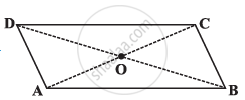
- AD = ______
- ∠DCB = ______
- OC = ______
- m∠DAB + m∠CDA = ______
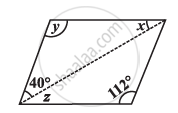
Consider the given parallelograms. Find the values of the unknowns x, y, z.
Can a quadrilateral ABCD be a parallelogram if ∠D + ∠B = 180°?
If the ratio of measures of two adjacent angles of a parallelogram is 1 : 2, find the measures of all angles of the parallelogram.
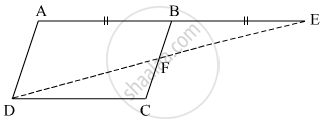
In the given figure, `square`ABCD is a parallelogram. Point E is on the ray AB such that BE = AB then prove that line ED bisects seg BC at point F.
Construct a parallelogram ABCD such that l(BC) = 7 cm, m∠ABC = 40° , l(AB) = 3 cm.
Referring the adjacent figure of a parallelogram, write the answer of questions given below.
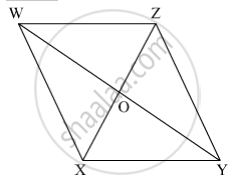
(1) If l(WZ) = 4.5 cm then l(XY) = ?
(2) If l(YZ) = 8.2 cm then l(XW) = ?
(3) If l(OX) = 2.5 cm then l(OZ) = ?
(4) If l(WO) = 3.3 cm then l(WY) = ?
(5) If m∠WZY = 120° then m∠WXY = ? and m∠XWZ = ?
Prove that the diagonals of a parallelogram bisect each other.
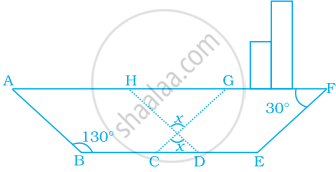
In the following figure of a ship, ABDH and CEFG are two parallelograms. Find the value of x.
In parallelogram ABCD, the angle bisector of ∠A bisects BC. Will angle bisector of B also bisect AD? Give reason.
