Advertisements
Advertisements
प्रश्न
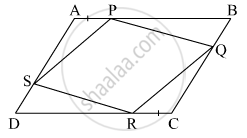
In the given figure, if points P, Q, R, S are on the sides of parallelogram such that AP = BQ = CR = DS then prove that `square`PQRS is a parallelogram.
Advertisements
उत्तर
Given: `square` ABCD is a parallelogram.
AP = BQ = CR = DS
To prove: `square`PQRS is a parallelogram.
Proof:
AP = CR ...(Given) ...(i)
`square`ABCD is a parallelogram.
AB = CD ...(opposite sides of parallelogram)
∴ AP + PB = CR + RD ...[A-P-B, D-R-C] ...(ii)
∴ PB = RD ...[From (i) and (ii)] ...(iii)
∠ABC ≅ ∠ADC ...(Opposite angles of parallelogram)
That is, ∠PBQ ≅ ∠RDS ...(A-P-B, B-Q-C, C-R-D and A-S-D) ...(iv)
In ΔPBQ and ΔRDS,
Seg PB ≅ Seg RD ...[From (iii)]
∠PBQ ≅ ∠RDS ...[From (iv)]
Seg BQ ≅ Seg SD ...(Given)
∴ ΔPBQ ≅ ΔRDS ...[SAS test]
Seg PQ ≅ Seg RS ...(c.s.c.t) ...(v)
Thus, we can prove that, ΔPAS ≅ ΔRCQ,
∴ Seg PS ≅ Seg RQ ...(vi)
In `square`PQRS,
Seg PQ ≅ Seg RS ...[From (v)]
Seg PS ≅ Seg RQ ...[from (vi)]
If the opposite sides of a quadrilateral are congruent, then it is a parallelogram.
∴ `square`PQRS is a parallelogram.
APPEARS IN
संबंधित प्रश्न
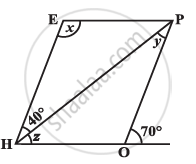
The adjacent figure HOPE is a parallelogram. Find the angle measures x, y and z. State the properties you use to find them.
Perimeter of a parallelogram is 150 cm. One of its sides is greater than the other side by 25 cm. Find the lengths of all sides.
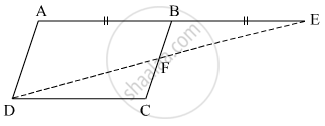
In the given figure, `square`ABCD is a parallelogram. Point E is on the ray AB such that BE = AB then prove that line ED bisects seg BC at point F.
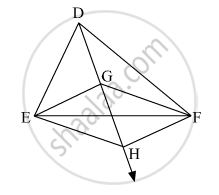
In the given figure, G is the point of concurrence of medians of ΔDEF. Take point H on ray DG such that D-G-H and DG = GH, then prove that `square`GEHF is a parallelogram.
Referring the adjacent figure of a parallelogram, write the answer of questions given below.
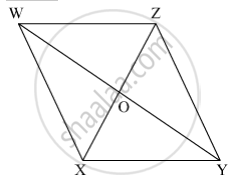
(1) If l(WZ) = 4.5 cm then l(XY) = ?
(2) If l(YZ) = 8.2 cm then l(XW) = ?
(3) If l(OX) = 2.5 cm then l(OZ) = ?
(4) If l(WO) = 3.3 cm then l(WY) = ?
(5) If m∠WZY = 120° then m∠WXY = ? and m∠XWZ = ?
ABCD is a parallelogram. What kind of quadrilateral is it if : AC = BD and AC is perpendicular to BD?
ABCD is a parallelogram. What kind of quadrilateral is it if: AC is perpendicular to BD but is not equal to it?
ABCD is a parallelogram. What kind of quadrilateral is it if: AC = BD but AC is not perpendicular to BD?
Prove that the diagonals of a parallelogram bisect each other.
In parallelogram ABCD, E is the mid-point of side AB and CE bisects angle BCD. Prove that:
- AE = AD,
- DE bisects and ∠ADC and
- Angle DEC is a right angle.
In parallelogram ABCD, X and Y are midpoints of opposite sides AB and DC respectively. Prove that:
(i) AX = YC
(ii) AX is parallel to YC
(iii) AXCY is a parallelogram.
If a triangle and a parallelogram lie on the same base and between the same parallels, then prove that the area of the triangle is equal to half of the area of parallelogram
Iron rods a, b, c, d, e, and f are making a design in a bridge as shown in the figure. If a || b, c || d, e || f, find the marked angles between b and c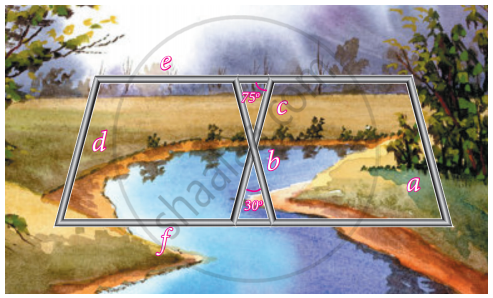
Iron rods a, b, c, d, e, and f are making a design in a bridge as shown in the figure. If a || b, c || d, e || f, find the marked angles between c and f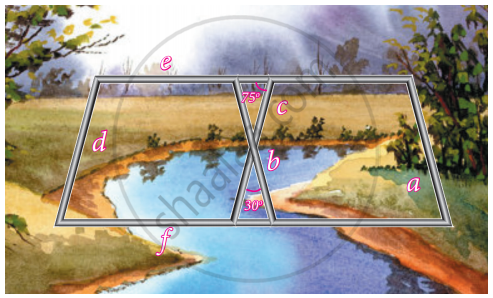
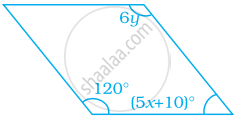
Find the values of x and y in the following parallelogram.
A diagonal of a parallelogram bisects an angle. Will it also bisect the other angle? Give reason.
In the following figure, FD || BC || AE and AC || ED. Find the value of x.