Advertisements
Advertisements
Question
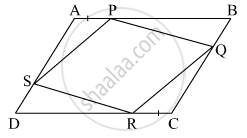
In the given figure, if points P, Q, R, S are on the sides of parallelogram such that AP = BQ = CR = DS then prove that `square`PQRS is a parallelogram.
Advertisements
Solution
Given: `square` ABCD is a parallelogram.
AP = BQ = CR = DS
To prove: `square`PQRS is a parallelogram.
Proof:
AP = CR ...(Given) ...(i)
`square`ABCD is a parallelogram.
AB = CD ...(opposite sides of parallelogram)
∴ AP + PB = CR + RD ...[A-P-B, D-R-C] ...(ii)
∴ PB = RD ...[From (i) and (ii)] ...(iii)
∠ABC ≅ ∠ADC ...(Opposite angles of parallelogram)
That is, ∠PBQ ≅ ∠RDS ...(A-P-B, B-Q-C, C-R-D and A-S-D) ...(iv)
In ΔPBQ and ΔRDS,
Seg PB ≅ Seg RD ...[From (iii)]
∠PBQ ≅ ∠RDS ...[From (iv)]
Seg BQ ≅ Seg SD ...(Given)
∴ ΔPBQ ≅ ΔRDS ...[SAS test]
Seg PQ ≅ Seg RS ...(c.s.c.t) ...(v)
Thus, we can prove that, ΔPAS ≅ ΔRCQ,
∴ Seg PS ≅ Seg RQ ...(vi)
In `square`PQRS,
Seg PQ ≅ Seg RS ...[From (v)]
Seg PS ≅ Seg RQ ...[from (vi)]
If the opposite sides of a quadrilateral are congruent, then it is a parallelogram.
∴ `square`PQRS is a parallelogram.
APPEARS IN
RELATED QUESTIONS
Given a parallelogram ABCD. Complete each statement along with the definition or property used.
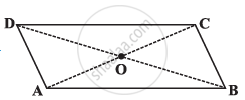
- AD = ______
- ∠DCB = ______
- OC = ______
- m∠DAB + m∠CDA = ______
Consider the given parallelogram. Find the values of the unknowns x, y, z.
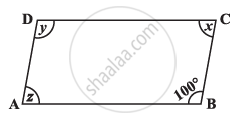
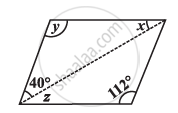
Consider the given parallelograms. Find the values of the unknowns x, y, z.
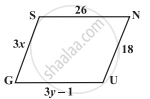
The following figure GUNS is a parallelogram. Find x and y. (Lengths are in cm)
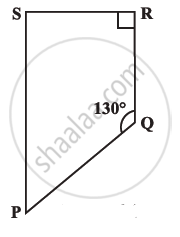
Find the measure of ∠P and ∠S, if `bar(SP) || bar(RQ)` in the following figure. (If you find m∠R, is there more than one method to find m∠P?).
If the ratio of measures of two adjacent angles of a parallelogram is 1 : 2, find the measures of all angles of the parallelogram.
Ratio of two adjacent sides of a parallelogram is 3 : 4, and its perimeter is 112 cm. Find the length of its each side.
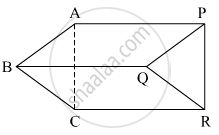
In the adjacent figure, if seg AB || seg PQ, seg AB ≅ seg PQ, seg AC || seg PR, seg AC ≅ seg PR then prove that, seg BC || seg QR and seg BC ≅ seg QR.
Referring the adjacent figure of a parallelogram, write the answer of questions given below.
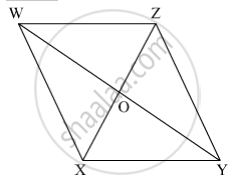
(1) If l(WZ) = 4.5 cm then l(XY) = ?
(2) If l(YZ) = 8.2 cm then l(XW) = ?
(3) If l(OX) = 2.5 cm then l(OZ) = ?
(4) If l(WO) = 3.3 cm then l(WY) = ?
(5) If m∠WZY = 120° then m∠WXY = ? and m∠XWZ = ?
In parallelogram PQRS, ∠Q = (4x – 5)° and ∠S = (3x + 10)°. Calculate: ∠Q and ∠R.
ABCD is a parallelogram. What kind of quadrilateral is it if: AC = BD but AC is not perpendicular to BD?
In the given figure, AB || EC, AB = AC and AE bisects ∠DAC. Prove that:
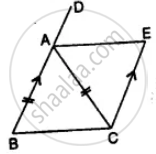
- ∠EAC = ∠ACB
- ABCE is a parallelogram.
Iron rods a, b, c, d, e, and f are making a design in a bridge as shown in the figure. If a || b, c || d, e || f, find the marked angles between c and f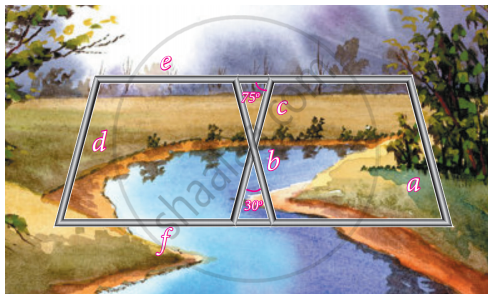
If two adjacent angles of a parallelogram are (5x – 5)° and (10x + 35)°, then the ratio of these angles is ______.
The angle between the two altitudes of a parallelogram through the same vertex of an obtuse angle of the parallelogram is 30°. The measure of the obtuse angle is ______.
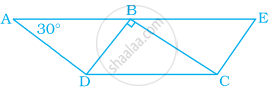
In the given figure, ABCD and BDCE are parallelograms with common base DC. If BC ⊥ BD, then ∠BEC = ______.
All rectangles are parallelograms.
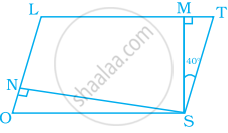
In parallelogram LOST, SN ⊥ OL and SM ⊥ LT. Find ∠STM, ∠SON and ∠NSM.
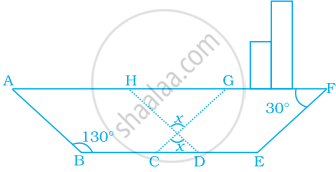
In the following figure of a ship, ABDH and CEFG are two parallelograms. Find the value of x.
Construct a parallelogram ABCD in which AB = 4 cm, BC = 5 cm and ∠B = 60°.
