Advertisements
Advertisements
Question
In parallelogram ABCD, the angle bisector of ∠A bisects BC. Will angle bisector of B also bisect AD? Give reason.
Advertisements
Solution
Given, ABCD is a parallelogram, bisector of ∠A, bisects BC at F, i.e. ∠1 = ∠2, CF = FB.
Draw FE || BA.
ABFE is a parallelogram by construction ...[∵ FE || BA]
⇒ ∠1 = ∠6 ...[Alternate angle]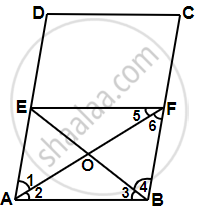
But ∠1 = ∠2 ...[Given]
∴ ∠2 = ∠6
AB = FB [Opposite sides to equal angles are equal] ...(i)
∴ ABFE is a rhombus.
Now, In ΔABO and ΔBOF,
AB = BF ...[From equation (i)]
BO = BO ...[Common]
AO = FO ...[Diagonals of rhombus bisect each other]
∴ ΔABO ≅ ΔBOF ...[By SSS]
∠3 = ∠4 ...[By CPCT]
Now, BF = `1/2` BC ...[Given]
⇒ BF = `1/2` AD ...[BC = AD]
⇒ AE = `1/2` AD ...[BF = AE]
∴ E is the midpoint of AD.
APPEARS IN
RELATED QUESTIONS
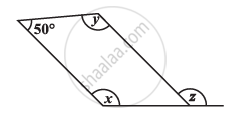
Consider the given parallelogram. Find the values of the unknowns x, y, z.
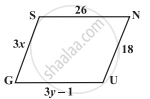
The following figure GUNS is a parallelogram. Find x and y. (Lengths are in cm)
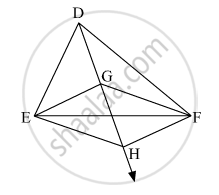
In the given figure, G is the point of concurrence of medians of ΔDEF. Take point H on ray DG such that D-G-H and DG = GH, then prove that `square`GEHF is a parallelogram.
In parallelogram PQRS, ∠Q = (4x – 5)° and ∠S = (3x + 10)°. Calculate: ∠Q and ∠R.
Iron rods a, b, c, d, e, and f are making a design in a bridge as shown in the figure. If a || b, c || d, e || f, find the marked angles between d and f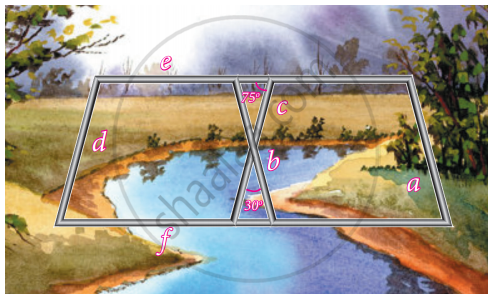
Which of the following figures satisfy the following properties?
- All sides are congruent.
- All angles are right angles.
- Opposite sides are parallel.
If two adjacent angles of a parallelogram are (5x – 5)° and (10x + 35)°, then the ratio of these angles is ______.
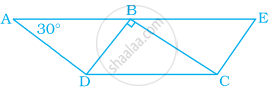
In the given figure, ABCD and BDCE are parallelograms with common base DC. If BC ⊥ BD, then ∠BEC = ______.
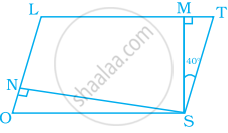
In parallelogram LOST, SN ⊥ OL and SM ⊥ LT. Find ∠STM, ∠SON and ∠NSM.
In parallelogram MODE, the bisector of ∠M and ∠O meet at Q, find the measure of ∠MQO.
