Advertisements
Advertisements
Question
Referring the adjacent figure of a parallelogram, write the answer of questions given below.
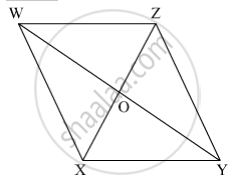
(1) If l(WZ) = 4.5 cm then l(XY) = ?
(2) If l(YZ) = 8.2 cm then l(XW) = ?
(3) If l(OX) = 2.5 cm then l(OZ) = ?
(4) If l(WO) = 3.3 cm then l(WY) = ?
(5) If m∠WZY = 120° then m∠WXY = ? and m∠XWZ = ?
Advertisements
Solution
WXYZ is a parallelogram.
(1) l(XY) = l(WZ) = 4.5 cm ...(Opposite sides of a parallelogram are congruent)
(2) l(XW) = l(YZ) = 8.2 cm ...(Opposite sides of a parallelogram are congruent)
(3) l(OZ) = l(OX) = 2.5 cm ...(Diagonals of parallelogram bisect each other)
(4) l(WY) = 2 × l(WO) = 2 × 3.3 = 6.6 cm ...(Diagonals of parallelogram bisect each other)
(5) m∠WXY = m∠WZY = 120º ...(Opposite angles of a parallelogram are congruent)
Now,
m∠WZY + m∠XWZ = 180º ...(Adjacent angles of a parallelogram are supplementary)
⇒ 120º + m∠XWZ = 180º
⇒ m∠XWZ = 180º − 120º = 60º
RELATED QUESTIONS
Consider the given parallelograms. Find the values of the unknowns x, y, z.
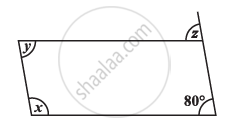
Can a quadrilateral ABCD be a parallelogram if ∠D + ∠B = 180°?
The following figure GUNS is a parallelogram. Find x and y. (Lengths are in cm)
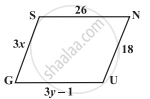
If the ratio of measures of two adjacent angles of a parallelogram is 1 : 2, find the measures of all angles of the parallelogram.
Ratio of two adjacent sides of a parallelogram is 3 : 4, and its perimeter is 112 cm. Find the length of its each side.
Given: Parallelogram ABCD in which diagonals AC and BD intersect at M.
Prove: M is the mid-point of LN.
In the given figure, ABCD and BDCE are parallelograms with common base DC. If BC ⊥ BD, then ∠BEC = ______.
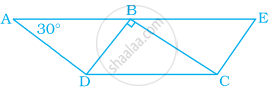
If opposite angles of a quadrilateral are equal, it must be a parallelogram.
In parallelogram MODE, the bisector of ∠M and ∠O meet at Q, find the measure of ∠MQO.
Construct a parallelogram when one of its side is 4 cm and its two diagonals are 5.6 cm and 7 cm. Measure the other side.
