Advertisements
Advertisements
Question
In parallelogram MODE, the bisector of ∠M and ∠O meet at Q, find the measure of ∠MQO.
Advertisements
Solution
Let MODE be a parallelogram and Q be the point of intersection of the bisector of ∠M and ∠O.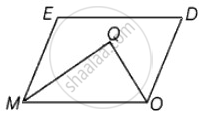
Since, MODE is a parallelogram
∴ ∠EMO + ∠DOM = 180° ...[∵ Adjacent angles are supplementary]
⇒ `1/2` ∠EMO + `1/2` ∠DOM = 90° ...[Dividing both sides by 2]
⇒ ∠QMO + ∠QOM = 90° ...(i)
Now, In ΔMOQ,
∠QOM + ∠QMO + ∠MQO = 180° ...[Angle sum property of triangle]
⇒ 90° + ∠MQO = 180° ...[From equation (i)]
∴ ∠MQO = 180° – 90° = 90°
APPEARS IN
RELATED QUESTIONS
Two adjacent angles of a parallelogram have equal measure. Find the measure of each of the angles of the parallelogram.
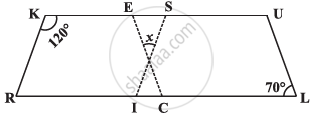
In the above figure both RISK and CLUE are parallelograms. Find the value of x.
Name the quadrilaterals whose diagonals bisect each other
Perimeter of a parallelogram is 150 cm. One of its sides is greater than the other side by 25 cm. Find the lengths of all sides.
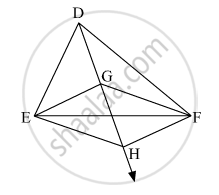
In the given figure, G is the point of concurrence of medians of ΔDEF. Take point H on ray DG such that D-G-H and DG = GH, then prove that `square`GEHF is a parallelogram.
Referring the adjacent figure of a parallelogram, write the answer of questions given below.
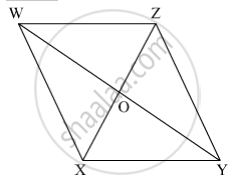
(1) If l(WZ) = 4.5 cm then l(XY) = ?
(2) If l(YZ) = 8.2 cm then l(XW) = ?
(3) If l(OX) = 2.5 cm then l(OZ) = ?
(4) If l(WO) = 3.3 cm then l(WY) = ?
(5) If m∠WZY = 120° then m∠WXY = ? and m∠XWZ = ?
Prove that the diagonals of a parallelogram bisect each other.
In parallelogram ABCD, E is the mid-point of side AB and CE bisects angle BCD. Prove that:
- AE = AD,
- DE bisects and ∠ADC and
- Angle DEC is a right angle.
Iron rods a, b, c, d, e, and f are making a design in a bridge as shown in the figure. If a || b, c || d, e || f, find the marked angles between d and f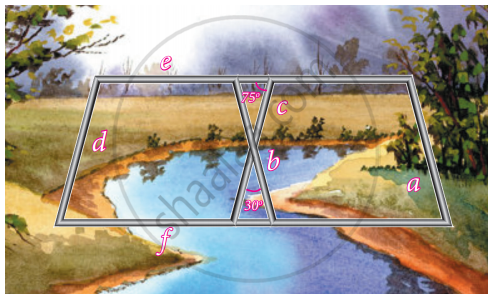
In the following figure, FD || BC || AE and AC || ED. Find the value of x.