Advertisements
Advertisements
Question
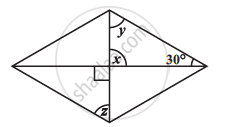
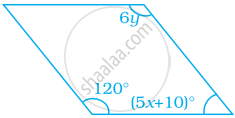
Consider the given parallelograms. Find the values of the unknowns x, y, z.
Advertisements
Solution
x = 90° (Vertically opposite angles)
x + y + 30° = 180° (Angle sum property of triangles)
90° + 30° + y = 180°
120° + y = 180°
y = 180° − 120° = 60° ...[Since alternate angles are equal in a parallelogram]
y = z = 60°
Thus x = 90°, y = 60° and z = 60°
RELATED QUESTIONS
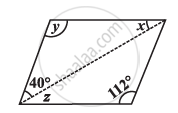
Consider the given parallelograms. Find the values of the unknowns x, y, z.
The measures of two adjacent angles of a parallelogram are in the ratio 3 : 2. Find the measure of each of the angles of the parallelogram.
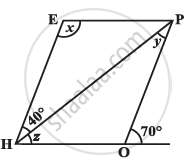
The adjacent figure HOPE is a parallelogram. Find the angle measures x, y and z. State the properties you use to find them.
Construct ☐ PQRS, such that l(PQ) = 3.5 cm, l(QR) = 5.6 cm, l(RS) = 3.5 cm, m∠Q = 110°, m∠R = 70°. If it is given that ☐ PQRS is a parallelogram, which of the given information is unnecessary?
In parallelogram ABCD, ∠A = 3 times ∠B. Find all the angles of the parallelogram. In the same parallelogram, if AB = 5x – 7 and CD = 3x +1 ; find the length of CD.
ABCD is a parallelogram. What kind of quadrilateral is it if : AC = BD and AC is perpendicular to BD?
ABCD is a parallelogram. What kind of quadrilateral is it if: AC is perpendicular to BD but is not equal to it?
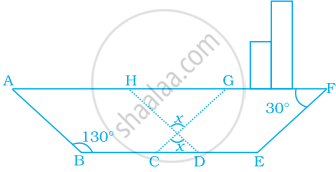
In the following figure of a ship, ABDH and CEFG are two parallelograms. Find the value of x.
Find the values of x and y in the following parallelogram.
ABCD is a parallelogram. Points P and Q are taken on the sides AB and AD respectively and the parallelogram PRQA is formed. If ∠C = 45°, find ∠R.
