Advertisements
Advertisements
प्रश्न
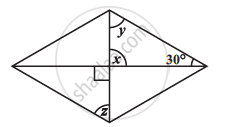
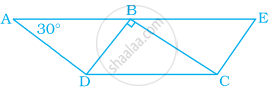
Consider the given parallelograms. Find the values of the unknowns x, y, z.
Advertisements
उत्तर
x = 90° (Vertically opposite angles)
x + y + 30° = 180° (Angle sum property of triangles)
90° + 30° + y = 180°
120° + y = 180°
y = 180° − 120° = 60° ...[Since alternate angles are equal in a parallelogram]
y = z = 60°
Thus x = 90°, y = 60° and z = 60°
संबंधित प्रश्न
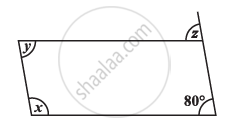
Consider the given parallelograms. Find the values of the unknowns x, y, z.
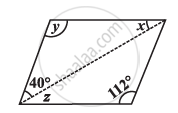
Consider the given parallelograms. Find the values of the unknowns x, y, z.
The measures of two adjacent angles of a parallelogram are in the ratio 3 : 2. Find the measure of each of the angles of the parallelogram.
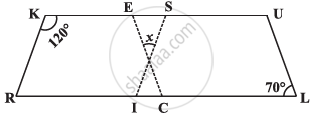
In the above figure both RISK and CLUE are parallelograms. Find the value of x.
In the given figure, `square`PQRS and `square`ABCR are two parallelograms. If ∠P = 110° then find the measures of all angles of `square`ABCR.

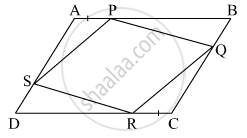
In the given figure, if points P, Q, R, S are on the sides of parallelogram such that AP = BQ = CR = DS then prove that `square`PQRS is a parallelogram.
Referring the adjacent figure of a parallelogram, write the answer of questions given below.
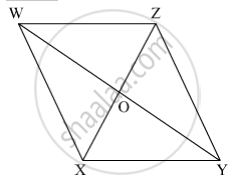
(1) If l(WZ) = 4.5 cm then l(XY) = ?
(2) If l(YZ) = 8.2 cm then l(XW) = ?
(3) If l(OX) = 2.5 cm then l(OZ) = ?
(4) If l(WO) = 3.3 cm then l(WY) = ?
(5) If m∠WZY = 120° then m∠WXY = ? and m∠XWZ = ?
Which of the following is a property of a parallelogram?
In the given figure, ABCD and BDCE are parallelograms with common base DC. If BC ⊥ BD, then ∠BEC = ______.
ABCD is a parallelogram. Points P and Q are taken on the sides AB and AD respectively and the parallelogram PRQA is formed. If ∠C = 45°, find ∠R.
