Advertisements
Advertisements
प्रश्न
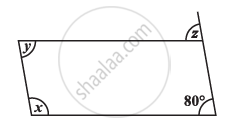
Consider the given parallelograms. Find the values of the unknowns x, y, z.
Advertisements
उत्तर
Since x + 80° = 180° ...[Sum of adjacent angles is 180°]
x = 180° − 80° = 100°
Also 80° = y ...[∵ Opposite angles are equal in a parallelogram]
And x = 180° − z ⇒ 100° = 180° − z
⇒ z = 180° − 100° = 80°
Thus x = 100°, y = 80° and z = 80°
संबंधित प्रश्न
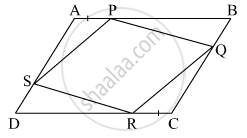
In the given figure, if points P, Q, R, S are on the sides of parallelogram such that AP = BQ = CR = DS then prove that `square`PQRS is a parallelogram.
In parallelogram ABCD, ∠A = 3 times ∠B. Find all the angles of the parallelogram. In the same parallelogram, if AB = 5x – 7 and CD = 3x +1 ; find the length of CD.
ABCD is a parallelogram. What kind of quadrilateral is it if: AC = BD but AC is not perpendicular to BD?
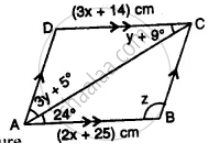
Use the information given in the alongside diagram to find the value of x, y, and z.
In the given figure, AB || EC, AB = AC and AE bisects ∠DAC. Prove that:
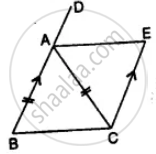
- ∠EAC = ∠ACB
- ABCE is a parallelogram.
If two adjacent angles of a parallelogram are (5x – 5)° and (10x + 35)°, then the ratio of these angles is ______.
In parallelogram MODE, the bisector of ∠M and ∠O meet at Q, find the measure of ∠MQO.
In parallelogram ABCD, the angle bisector of ∠A bisects BC. Will angle bisector of B also bisect AD? Give reason.
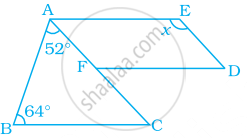
In the following figure, FD || BC || AE and AC || ED. Find the value of x.
Draw a rough figure of a quadrilateral that is not a parallelogram but has exactly two opposite angles of equal measure.
