Advertisements
Advertisements
Question
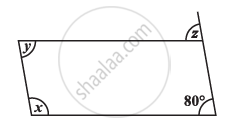
Consider the given parallelograms. Find the values of the unknowns x, y, z.
Advertisements
Solution
Since x + 80° = 180° ...[Sum of adjacent angles is 180°]
x = 180° − 80° = 100°
Also 80° = y ...[∵ Opposite angles are equal in a parallelogram]
And x = 180° − z ⇒ 100° = 180° − z
⇒ z = 180° − 100° = 80°
Thus x = 100°, y = 80° and z = 80°
RELATED QUESTIONS
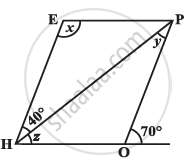
The adjacent figure HOPE is a parallelogram. Find the angle measures x, y and z. State the properties you use to find them.
Name the quadrilaterals whose diagonals bisect each other
If the ratio of measures of two adjacent angles of a parallelogram is 1 : 2, find the measures of all angles of the parallelogram.
Ratio of consecutive angles of a quadrilateral is 1 : 2 : 3 : 4. Find the measure of its each angle. Write, with reason, what type of a quadrilateral it is.
Prove that the diagonals of a parallelogram bisect each other.
Iron rods a, b, c, d, e, and f are making a design in a bridge as shown in the figure. If a || b, c || d, e || f, find the marked angles between d and e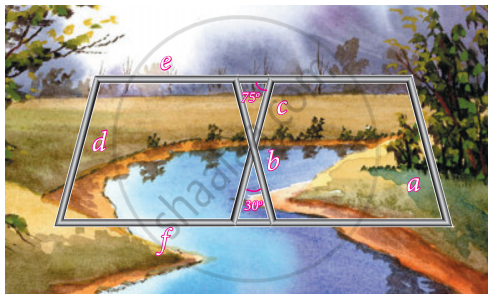
The angle between the two altitudes of a parallelogram through the same vertex of an obtuse angle of the parallelogram is 30°. The measure of the obtuse angle is ______.
Construct a parallelogram when one of its side is 4 cm and its two diagonals are 5.6 cm and 7 cm. Measure the other side.
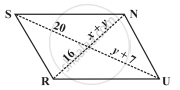
The following figure RUNS is parallelogram. Find x and y. (Lengths are in cm)
Draw a rough figure of a quadrilateral that is not a parallelogram but has exactly two opposite angles of equal measure.
