Advertisements
Advertisements
Question
Construct a parallelogram when one of its side is 4 cm and its two diagonals are 5.6 cm and 7 cm. Measure the other side.
Advertisements
Solution
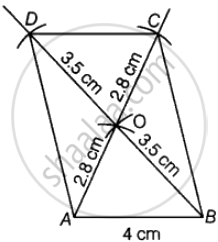
Steps of construction:
Step I: Draw AB = 4 cm.
Step II: With A as centre and radius 2.8 cm, draw an arc.
Step III: With B as centre and radius 3.5 cm, draw another arc cutting the previous arc at O.
Step IV: Join OA and OB.
Step V: Produce AO to C that is OC = AO and produce BO to D that is OD = BD.
Step VI: Join AD, BC and CD.
Hence, ABCD is the required parallelogram.
APPEARS IN
RELATED QUESTIONS
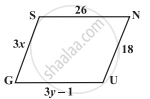
The following figure GUNS is a parallelogram. Find x and y. (Lengths are in cm)
Construct ☐ BARC such that l(BA) = l(BC) = 4.2 cm, l(AC) = 6.0 cm, l(AR) = l(CR) = 5.6 cm
Ratio of consecutive angles of a quadrilateral is 1 : 2 : 3 : 4. Find the measure of its each angle. Write, with reason, what type of a quadrilateral it is.
ABCD is a parallelogram. What kind of quadrilateral is it if : AC = BD and AC is perpendicular to BD?
Iron rods a, b, c, d, e, and f are making a design in a bridge as shown in the figure. If a || b, c || d, e || f, find the marked angles between d and e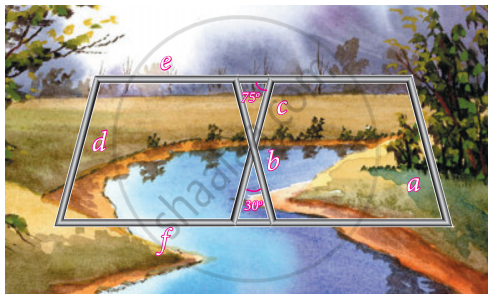
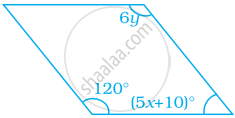
Find the values of x and y in the following parallelogram.
Two angles of a quadrilateral are each of measure 75° and the other two angles are equal. What is the measure of these two angles? Name the possible figures so formed.
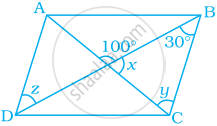
ABCD is a parallelogram. Find the value of x, y and z.
A diagonal of a parallelogram bisects an angle. Will it also bisect the other angle? Give reason.
Draw a rough figure of a quadrilateral that is not a parallelogram but has exactly two opposite angles of equal measure.
