Advertisements
Advertisements
Question
Construct ☐ BARC such that l(BA) = l(BC) = 4.2 cm, l(AC) = 6.0 cm, l(AR) = l(CR) = 5.6 cm
Advertisements
Solution
Steps of Construction:
Step 1: Draw BA = 4.2 cm.
Step 2: With B as the centre and a radius of 4.2 cm, draw an arc.
Step 3: With A as the centre and a radius of 6 cm, draw an arc cutting the previous arc at C.
Step 4: Join BC.
Step 5: With A as the centre and a radius of 5.6 cm, draw an arc.
Step 6: With C as the centre and a radius of 5.6 cm, draw an arc cutting the previous arc at R.
Step 7: Join AR and CR.
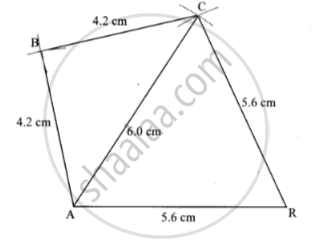
Here, BARC is the required quadrilateral.
RELATED QUESTIONS
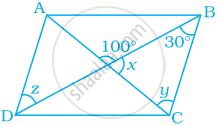
Consider the given parallelograms. Find the values of the unknowns x, y, z.
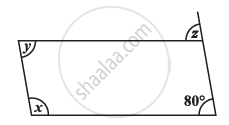
The measures of two adjacent angles of a parallelogram are in the ratio 3 : 2. Find the measure of each of the angles of the parallelogram.
If the ratio of measures of two adjacent angles of a parallelogram is 1 : 2, find the measures of all angles of the parallelogram.
In the given figure, `square`PQRS and `square`ABCR are two parallelograms. If ∠P = 110° then find the measures of all angles of `square`ABCR.

In parallelogram PQRS, ∠Q = (4x – 5)° and ∠S = (3x + 10)°. Calculate: ∠Q and ∠R.
In parallelogram ABCD, E is the mid-point of AD and F is the mid-point of BC. Prove that BFDE is a parallelogram.
In parallelogram ABCD, E is the mid-point of side AB and CE bisects angle BCD. Prove that:
- AE = AD,
- DE bisects and ∠ADC and
- Angle DEC is a right angle.
If opposite angles of a quadrilateral are equal, it must be a parallelogram.
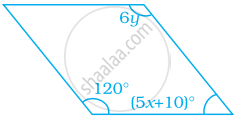
Find the values of x and y in the following parallelogram.
ABCD is a parallelogram. Find the value of x, y and z.