Advertisements
Advertisements
Question
If opposite angles of a quadrilateral are equal, it must be a parallelogram.
Options
True
False
Advertisements
Solution
This statement is True.
Explanation:
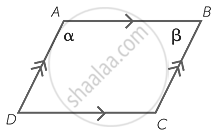
⇒ Let ABCD be a parallelogram, with A = α and B = β.
We have to prove that C = α and D = β.
⇒ α + β = 180° (co-interior angles, AD || BC),
⇒ ∠C = α (co-interior angles, AB || DC)
⇒ ∠D = β (co-interior angles, AB || DC).
APPEARS IN
RELATED QUESTIONS
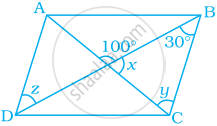
Consider the given parallelogram. Find the values of the unknowns x, y, z.
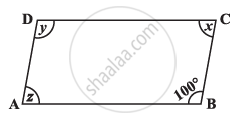
Can a quadrilateral ABCD be a parallelogram if ∠D + ∠B = 180°?
Can a quadrilateral ABCD be a parallelogram if ∠A = 70° and ∠C = 65°?
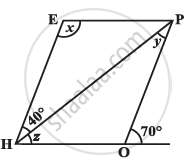
The adjacent figure HOPE is a parallelogram. Find the angle measures x, y and z. State the properties you use to find them.
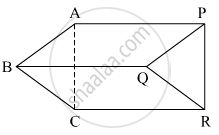
In the adjacent figure, if seg AB || seg PQ, seg AB ≅ seg PQ, seg AC || seg PR, seg AC ≅ seg PR then prove that, seg BC || seg QR and seg BC ≅ seg QR.
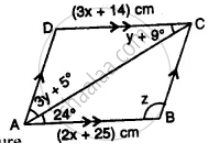
Use the information given in the alongside diagram to find the value of x, y, and z.
Iron rods a, b, c, d, e, and f are making a design in a bridge as shown in the figure. If a || b, c || d, e || f, find the marked angles between d and f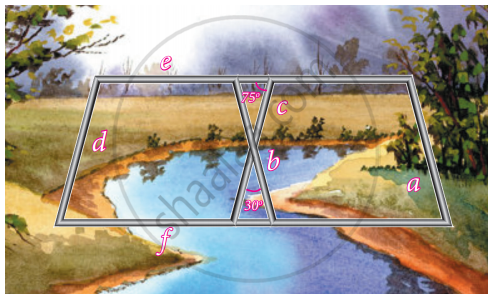
Iron rods a, b, c, d, e, and f are making a design in a bridge as shown in the figure. If a || b, c || d, e || f, find the marked angles between c and f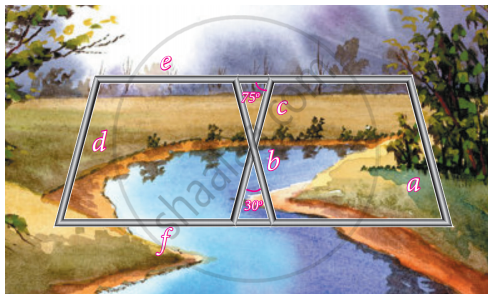
ABCD is a parallelogram. Find the value of x, y and z.
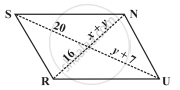
The following figure RUNS is parallelogram. Find x and y. (Lengths are in cm)