Advertisements
Advertisements
प्रश्न
Construct ☐ BARC such that l(BA) = l(BC) = 4.2 cm, l(AC) = 6.0 cm, l(AR) = l(CR) = 5.6 cm
Advertisements
उत्तर
Steps of Construction:
Step 1: Draw BA = 4.2 cm.
Step 2: With B as the centre and a radius of 4.2 cm, draw an arc.
Step 3: With A as the centre and a radius of 6 cm, draw an arc cutting the previous arc at C.
Step 4: Join BC.
Step 5: With A as the centre and a radius of 5.6 cm, draw an arc.
Step 6: With C as the centre and a radius of 5.6 cm, draw an arc cutting the previous arc at R.
Step 7: Join AR and CR.
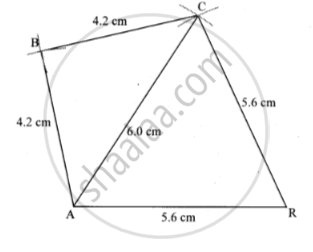
Here, BARC is the required quadrilateral.
संबंधित प्रश्न
Can a quadrilateral ABCD be a parallelogram if AB = DC = 8 cm, AD = 4 cm and BC = 4.4 cm?
The measures of two adjacent angles of a parallelogram are in the ratio 3 : 2. Find the measure of each of the angles of the parallelogram.
Two adjacent angles of a parallelogram have equal measure. Find the measure of each of the angles of the parallelogram.
PQRS is a parallelogram whose diagonals intersect at M.
If ∠PMS = 54°, ∠QSR = 25° and ∠SQR = 30° ; find :
(i) ∠RPS
(ii) ∠PRS
(iii) ∠PSR.
The given figure shows parallelogram ABCD. Points M and N lie in diagonal BD such that DM = BN.
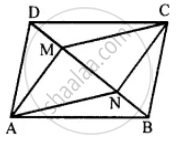
Prove that:
(i) ∆DMC = ∆BNA and so CM = AN
(ii) ∆AMD = ∆CNB and so AM CN
(iii) ANCM is a parallelogram.
Iron rods a, b, c, d, e, and f are making a design in a bridge as shown in the figure. If a || b, c || d, e || f, find the marked angles between c and f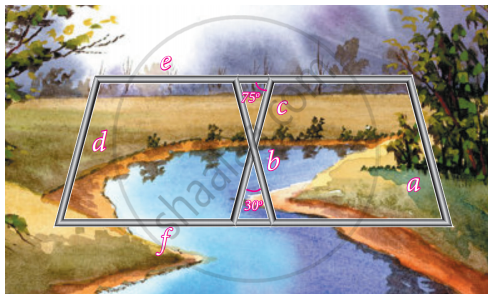
Two angles of a quadrilateral are each of measure 75° and the other two angles are equal. What is the measure of these two angles? Name the possible figures so formed.
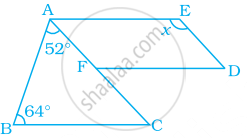
In the following figure, FD || BC || AE and AC || ED. Find the value of x.
Construct a parallelogram HOME with HO = 6 cm, HE = 4 cm and OE = 3 cm.
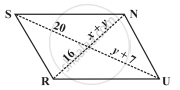
The following figure RUNS is parallelogram. Find x and y. (Lengths are in cm)