Advertisements
Advertisements
प्रश्न
Ratio of consecutive angles of a quadrilateral is 1 : 2 : 3 : 4. Find the measure of its each angle. Write, with reason, what type of a quadrilateral it is.
Advertisements
उत्तर
Suppose PQRS is a quadrilateral.
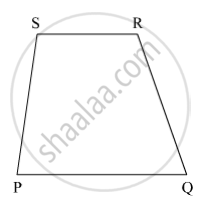
Let m∠P : m∠Q : m∠R : m∠S = 1 : 2 : 3 : 4
So, m∠P = k, m∠Q = 2k, m∠R = 3k and m∠S = 4k, where k is some constant
Now,
m∠P + m∠Q + m∠R + m∠S = 360°
∴ k + 2k + 3k + 4k = 360°
⇒ 10k = 360°
⇒ k = 36°
∴ m∠P = 36°
m∠Q = 2k = 2 × 36° = 72°
m∠R = 3k = 3 × 36° = 108°
m∠S = 4k = 4 × 36° = 144°
Now, m∠P + m∠S = 36° + 144° = 180°
We know if two lines are intersected by a transversal such that the sum of interior angles on the same transversal is supplementary, then the two lines are parallel.
∴ Side PQ || Side SR
Also, m∠P + m∠Q = 36° + 72° = 108° ≠ 180°
So, side PS is not parallel to side QR.
In quadrilateral PQRS, only one pair of opposite sides is parallel. Therefore, quadrilateral PQRS is a trapezium.
संबंधित प्रश्न
Can a quadrilateral ABCD be a parallelogram if ∠A = 70° and ∠C = 65°?
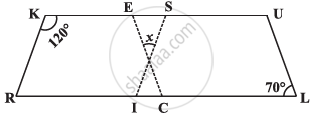
In the above figure both RISK and CLUE are parallelograms. Find the value of x.
Perimeter of a parallelogram is 150 cm. One of its sides is greater than the other side by 25 cm. Find the lengths of all sides.
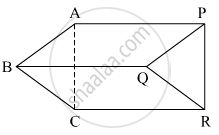
In the adjacent figure, if seg AB || seg PQ, seg AB ≅ seg PQ, seg AC || seg PR, seg AC ≅ seg PR then prove that, seg BC || seg QR and seg BC ≅ seg QR.
Construct ☐ PQRS, such that l(PQ) = 3.5 cm, l(QR) = 5.6 cm, l(RS) = 3.5 cm, m∠Q = 110°, m∠R = 70°. If it is given that ☐ PQRS is a parallelogram, which of the given information is unnecessary?
ABCD is a parallelogram. What kind of quadrilateral is it if: AC = BD but AC is not perpendicular to BD?
In parallelogram ABCD, X and Y are midpoints of opposite sides AB and DC respectively. Prove that:
(i) AX = YC
(ii) AX is parallel to YC
(iii) AXCY is a parallelogram.
Two angles of a quadrilateral are each of measure 75° and the other two angles are equal. What is the measure of these two angles? Name the possible figures so formed.
ABCD is a parallelogram. The bisector of angle A intersects CD at X and bisector of angle C intersects AB at Y. Is AXCY a parallelogram? Give reason.
Draw a rough figure of a quadrilateral that is not a parallelogram but has exactly two opposite angles of equal measure.
