Advertisements
Advertisements
प्रश्न
In parallelogram PQRS, O is the mid point of SQ. Find ∠S, ∠R, PQ, QR and diagonal PR.

Advertisements
उत्तर
Given, ∠RQY = 60°
∴ ∠RQP = 120° ...[Linear pair]
∴ ∠S = 120° ...[∵ Opposite angles are equal in a parallelogram]
By the angle sum property of a quadrilateral,
∠P + ∠R + ∠S + ∠Q = 360°
⇒ ∠P + ∠R + 120° + 120° = 360°
⇒ ∠P + ∠R + 120°
⇒ 2∠P = 120°
⇒ ∠P = 60° ...[∵ Opposite angles are equal in parallelogram]
⇒ ∠P = ∠R = 60°
Also, SR = 15 cm
∴ PQ = 15 cm ...[∵ Opposite sides of a parallelogram are equal]
And PS = 11 cm
∴ QR = 11 cm ...[∵ Opposite sides of a parallelogram are equal]
And PR = 2 × PO
= 2 × 6
= 12 cm ...[∵ Diagonals of a parallelogram bisect each other]
APPEARS IN
संबंधित प्रश्न
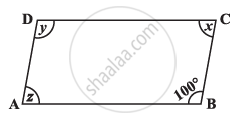
Consider the given parallelogram. Find the values of the unknowns x, y, z.
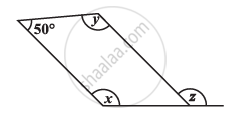
Consider the given parallelogram. Find the values of the unknowns x, y, z.
Can a quadrilateral ABCD be a parallelogram if AB = DC = 8 cm, AD = 4 cm and BC = 4.4 cm?
ABCD is a parallelogram. What kind of quadrilateral is it if: AC = BD but AC is not perpendicular to BD?
In the following diagram, the bisectors of interior angles of the parallelogram PQRS enclose a quadrilateral ABCD.
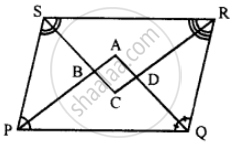
Show that:
(i) ∠PSB + ∠SPB = 90°
(ii) ∠PBS = 90°
(iii) ∠ABC = 90°
(iv) ∠ADC = 90°
(v) ∠A = 90°
(vi) ABCD is a rectangle
Thus, the bisectors of the angles of a parallelogram enclose a rectangle.
The angle between the two altitudes of a parallelogram through the same vertex of an obtuse angle of the parallelogram is 30°. The measure of the obtuse angle is ______.
If opposite angles of a quadrilateral are equal, it must be a parallelogram.
In parallelogram MODE, the bisector of ∠M and ∠O meet at Q, find the measure of ∠MQO.
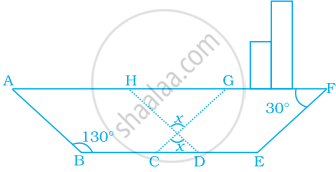
In the following figure of a ship, ABDH and CEFG are two parallelograms. Find the value of x.
A diagonal of a parallelogram bisects an angle. Will it also bisect the other angle? Give reason.
