Advertisements
Advertisements
Question
Ratio of consecutive angles of a quadrilateral is 1 : 2 : 3 : 4. Find the measure of its each angle. Write, with reason, what type of a quadrilateral it is.
Advertisements
Solution
Suppose PQRS is a quadrilateral.
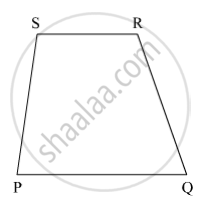
Let m∠P : m∠Q : m∠R : m∠S = 1 : 2 : 3 : 4
So, m∠P = k, m∠Q = 2k, m∠R = 3k and m∠S = 4k, where k is some constant
Now,
m∠P + m∠Q + m∠R + m∠S = 360°
∴ k + 2k + 3k + 4k = 360°
⇒ 10k = 360°
⇒ k = 36°
∴ m∠P = 36°
m∠Q = 2k = 2 × 36° = 72°
m∠R = 3k = 3 × 36° = 108°
m∠S = 4k = 4 × 36° = 144°
Now, m∠P + m∠S = 36° + 144° = 180°
We know if two lines are intersected by a transversal such that the sum of interior angles on the same transversal is supplementary, then the two lines are parallel.
∴ Side PQ || Side SR
Also, m∠P + m∠Q = 36° + 72° = 108° ≠ 180°
So, side PS is not parallel to side QR.
In quadrilateral PQRS, only one pair of opposite sides is parallel. Therefore, quadrilateral PQRS is a trapezium.
RELATED QUESTIONS
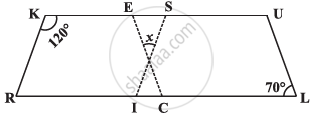
In the above figure both RISK and CLUE are parallelograms. Find the value of x.
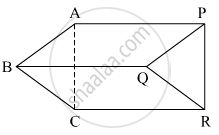
In the adjacent figure, if seg AB || seg PQ, seg AB ≅ seg PQ, seg AC || seg PR, seg AC ≅ seg PR then prove that, seg BC || seg QR and seg BC ≅ seg QR.
Referring the adjacent figure of a parallelogram, write the answer of questions given below.
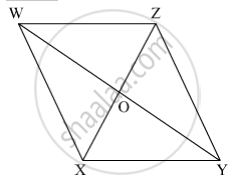
(1) If l(WZ) = 4.5 cm then l(XY) = ?
(2) If l(YZ) = 8.2 cm then l(XW) = ?
(3) If l(OX) = 2.5 cm then l(OZ) = ?
(4) If l(WO) = 3.3 cm then l(WY) = ?
(5) If m∠WZY = 120° then m∠WXY = ? and m∠XWZ = ?
In parallelogram PQRS, ∠Q = (4x – 5)° and ∠S = (3x + 10)°. Calculate: ∠Q and ∠R.
ABCD is a parallelogram. What kind of quadrilateral is it if: AC = BD but AC is not perpendicular to BD?
If a triangle and a parallelogram lie on the same base and between the same parallels, then prove that the area of the triangle is equal to half of the area of parallelogram
Iron rods a, b, c, d, e, and f are making a design in a bridge as shown in the figure. If a || b, c || d, e || f, find the marked angles between d and e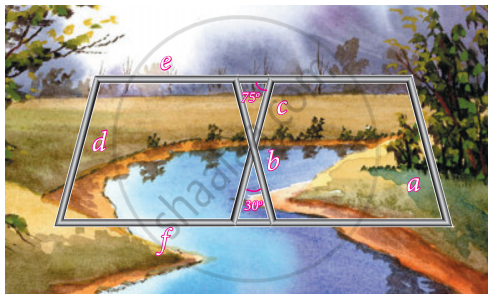
The adjacent sides of a parallelogram are 5 cm and 9 cm. Its perimeter is ______.
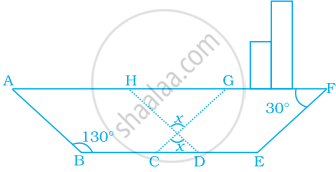
In the following figure of a ship, ABDH and CEFG are two parallelograms. Find the value of x.
The angle between the two altitudes of a parallelogram through the vertex of an obtuse angle of the parallelogram is 45°. Find the angles of the parallelogram.
