Advertisements
Advertisements
Question
Construct a parallelogram ABCD in which AB = 4 cm, BC = 5 cm and ∠B = 60°.
Advertisements
Solution
As we know that the opposite sides of a parallelogram are equal.
So, AB = DC = 4 cm
BC = AD = 5 cm
∠B = 60°
∠A + ∠B = 180° ...[Sum of cointerior angles]
∠A = 180°
Steps of construction:
Step I: Draw AB = 4 cm.
Step II: Draw ray BX that is ∠ABX = 60°.
Step III: Mark a point C that is BC = 5 cm.
Step IV: Draw a ray AY that is ∠YAB = 120.
Step V: Mark a point D that is AD = 5 cm.
Step VI: Join C and D.
Hence, ABCD is required parallelogram.
APPEARS IN
RELATED QUESTIONS
If the ratio of measures of two adjacent angles of a parallelogram is 1 : 2, find the measures of all angles of the parallelogram.
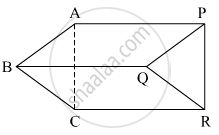
In the adjacent figure, if seg AB || seg PQ, seg AB ≅ seg PQ, seg AC || seg PR, seg AC ≅ seg PR then prove that, seg BC || seg QR and seg BC ≅ seg QR.
Referring the adjacent figure of a parallelogram, write the answer of questions given below.
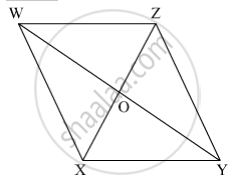
(1) If l(WZ) = 4.5 cm then l(XY) = ?
(2) If l(YZ) = 8.2 cm then l(XW) = ?
(3) If l(OX) = 2.5 cm then l(OZ) = ?
(4) If l(WO) = 3.3 cm then l(WY) = ?
(5) If m∠WZY = 120° then m∠WXY = ? and m∠XWZ = ?
Iron rods a, b, c, d, e, and f are making a design in a bridge as shown in the figure. If a || b, c || d, e || f, find the marked angles between d and e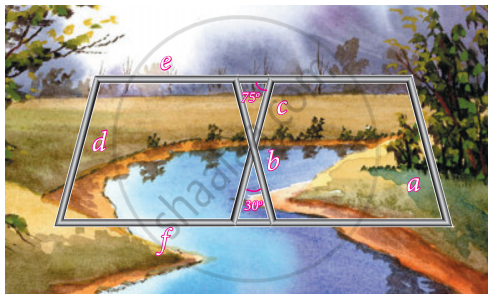
Iron rods a, b, c, d, e, and f are making a design in a bridge as shown in the figure. If a || b, c || d, e || f, find the marked angles between c and f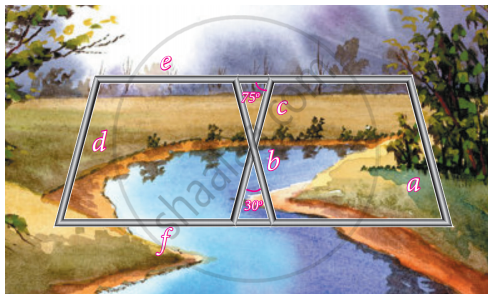
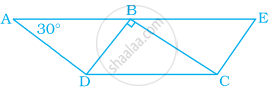
In the given figure, ABCD and BDCE are parallelograms with common base DC. If BC ⊥ BD, then ∠BEC = ______.
The adjacent sides of a parallelogram are 5 cm and 9 cm. Its perimeter is ______.
In parallelogram PQRS, O is the mid point of SQ. Find ∠S, ∠R, PQ, QR and diagonal PR.

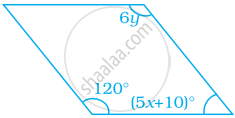
Find the values of x and y in the following parallelogram.
Construct a parallelogram HOME with HO = 6 cm, HE = 4 cm and OE = 3 cm.
