Advertisements
Advertisements
Question
Construct a trapezium ABCD in which AB || DC, ∠A = 105°, AD = 3 cm, AB = 4 cm and CD = 8 cm.
Advertisements
Solution
We know that,
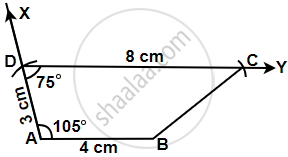
∠A + ∠D = 180° ...[Sum of adjacent angle of a trapezium is 180°]
105° + ∠D = 180°
∠D = 180° – 105°
∠D = 75°
Steps of construction:
Step I: Draw AB = 4 cm.
Step II: Draw `bar(AX)` that is ∠BAX = 105°.
Step III: Mark a point D on AX that is AD = 3 cm.
Step IV: Draw `bar(DY)` that is ∠ADY = 75°.
Step V: Mark a point C that is CD = 8 cm.
Step VI: Join BC.
Hence, ABCD is the required trapezium.
APPEARS IN
RELATED QUESTIONS
Explain how this figure is a trapezium. Which of its two sides are parallel?
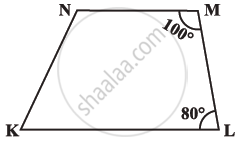
In `square`ABCD, side BC || side AD, side AB ≅ side DC If ∠A = 72° then find the measure of ∠B and ∠D.
In `square`ABCD, side BC < side AD in following figure. side BC || side AD and if side BA ≅ side CD then prove that ∠ABC ≅ ∠DCB.
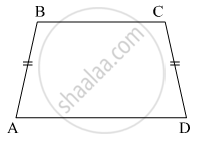
Which of the following figures satisfy the following property?
- Only one pair of sides are parallel.
Which of the following properties describe a trapezium?
In trapezium ABCD with AB || CD, if ∠A = 100°, then ∠D = ______.
Every trapezium is a parallelogram.
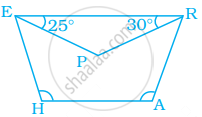
In trapezium HARE, EP and RP are bisectors of ∠E and ∠R respectively. Find ∠HAR and ∠EHA.
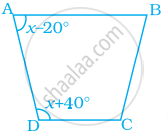
Find the value of x in the trapezium ABCD given below.
Construct a trapezium RISK in which RI || KS, RI = 7 cm, IS = 5 cm, RK = 6.5 cm and ∠I = 60°.
