Advertisements
Advertisements
प्रश्न
Construct a trapezium ABCD in which AB || DC, ∠A = 105°, AD = 3 cm, AB = 4 cm and CD = 8 cm.
Advertisements
उत्तर
We know that,
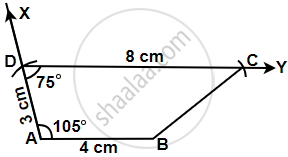
∠A + ∠D = 180° ...[Sum of adjacent angle of a trapezium is 180°]
105° + ∠D = 180°
∠D = 180° – 105°
∠D = 75°
Steps of construction:
Step I: Draw AB = 4 cm.
Step II: Draw `bar(AX)` that is ∠BAX = 105°.
Step III: Mark a point D on AX that is AD = 3 cm.
Step IV: Draw `bar(DY)` that is ∠ADY = 75°.
Step V: Mark a point C that is CD = 8 cm.
Step VI: Join BC.
Hence, ABCD is the required trapezium.
APPEARS IN
संबंधित प्रश्न
Explain how this figure is a trapezium. Which of its two sides are parallel?
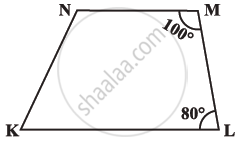
In `square` IJKL, side IJ || side KL, ∠I = 108°, ∠K = 53° then find the measure of ∠J and ∠L.
In an Isosceles-trapezium, show that the opposite angles are supplementary.
Which of the following properties describe a trapezium?
PQRS is a trapezium in which PQ || SR and ∠P = 130°, ∠Q = 110°. Then ∠R is equal to ______.
A quadrilateral in which a pair of opposite sides is parallel is ______.
In trapezium ABCD with AB || CD, if ∠A = 100°, then ∠D = ______.
Of the four quadrilaterals-square, rectangle, rhombus and trapezium-one is somewhat different from the others because of its design. Find it and give justification.
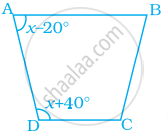
Find the value of x in the trapezium ABCD given below.
ABCD is a trapezium such that AB || CD, ∠A : ∠D = 2 : 1, ∠B : ∠C = 7 : 5. Find the angles of the trapezium.
