Advertisements
Advertisements
प्रश्न
Construct ☐ PQRS, such that l(PQ) = 3.5 cm, l(QR) = 5.6 cm, l(RS) = 3.5 cm, m∠Q = 110°, m∠R = 70°. If it is given that ☐ PQRS is a parallelogram, which of the given information is unnecessary?
Advertisements
उत्तर
Steps of Construction:
Step 1: Draw PQ = 3.5 cm.
Step 2: Draw ∠PQX = 110°.
Step 3: With Q as the center and a radius of 5.6 cm, draw an arc-cutting ray QX at R.
Step 4: Draw ∠QRY = 70°.
Step 5: With R as centre and radius 3.5 cm, draw an arc cutting ray RY at S.
Step 6: Join PS.
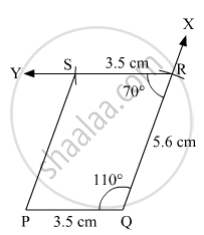
Here, PQRS is the required quadrilateral.
If it is given that quadrilateral PQRS is a parallelogram, then the information l(RS) = 3.5 cm and m∠R = 70° is unnecessary.
संबंधित प्रश्न
Can a quadrilateral ABCD be a parallelogram if ∠D + ∠B = 180°?
Two adjacent angles of a parallelogram have equal measure. Find the measure of each of the angles of the parallelogram.
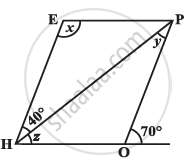
The adjacent figure HOPE is a parallelogram. Find the angle measures x, y and z. State the properties you use to find them.
Name the quadrilaterals whose diagonals bisect each other
Construct ☐ BARC such that l(BA) = l(BC) = 4.2 cm, l(AC) = 6.0 cm, l(AR) = l(CR) = 5.6 cm
ABCD is a parallelogram. What kind of quadrilateral is it if: AC = BD but AC is not perpendicular to BD?
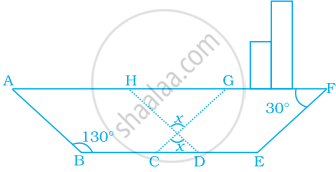
In the following figure of a ship, ABDH and CEFG are two parallelograms. Find the value of x.
Two angles of a quadrilateral are each of measure 75° and the other two angles are equal. What is the measure of these two angles? Name the possible figures so formed.
In parallelogram ABCD, the angle bisector of ∠A bisects BC. Will angle bisector of B also bisect AD? Give reason.
Construct a parallelogram when one of its side is 4 cm and its two diagonals are 5.6 cm and 7 cm. Measure the other side.
