Advertisements
Advertisements
प्रश्न
Construct a parallelogram when one of its side is 4 cm and its two diagonals are 5.6 cm and 7 cm. Measure the other side.
Advertisements
उत्तर
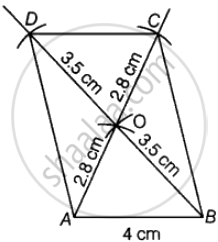
Steps of construction:
Step I: Draw AB = 4 cm.
Step II: With A as centre and radius 2.8 cm, draw an arc.
Step III: With B as centre and radius 3.5 cm, draw another arc cutting the previous arc at O.
Step IV: Join OA and OB.
Step V: Produce AO to C that is OC = AO and produce BO to D that is OD = BD.
Step VI: Join AD, BC and CD.
Hence, ABCD is the required parallelogram.
APPEARS IN
संबंधित प्रश्न
Given a parallelogram ABCD. Complete each statement along with the definition or property used.
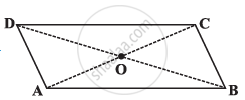
- AD = ______
- ∠DCB = ______
- OC = ______
- m∠DAB + m∠CDA = ______
Construct ☐ PQRS, such that l(PQ) = 3.5 cm, l(QR) = 5.6 cm, l(RS) = 3.5 cm, m∠Q = 110°, m∠R = 70°. If it is given that ☐ PQRS is a parallelogram, which of the given information is unnecessary?
In parallelogram ABCD, E is the mid-point of AD and F is the mid-point of BC. Prove that BFDE is a parallelogram.
In parallelogram ABCD, E is the mid-point of side AB and CE bisects angle BCD. Prove that:
- AE = AD,
- DE bisects and ∠ADC and
- Angle DEC is a right angle.
Which of the following is a property of a parallelogram?
If two adjacent angles of a parallelogram are (5x – 5)° and (10x + 35)°, then the ratio of these angles is ______.
The angle between the two altitudes of a parallelogram through the same vertex of an obtuse angle of the parallelogram is 30°. The measure of the obtuse angle is ______.
The adjacent sides of a parallelogram are 5 cm and 9 cm. Its perimeter is ______.
All rectangles are parallelograms.
In parallelogram PQRS, O is the mid point of SQ. Find ∠S, ∠R, PQ, QR and diagonal PR.

