Advertisements
Advertisements
प्रश्न
The adjacent sides of a parallelogram are 5 cm and 9 cm. Its perimeter is ______.
Advertisements
उत्तर
The adjacent sides of a parallelogram are 5 cm and 9 cm. Its perimeter is 28 cm.
Explanation:
Perimeter of a parallelogram = 2(Sum of lengths of adjacent sides)
= 2(5 + 9)
= 2 × 14
= 28 cm
APPEARS IN
संबंधित प्रश्न
Can a quadrilateral ABCD be a parallelogram if ∠D + ∠B = 180°?
Can a quadrilateral ABCD be a parallelogram if AB = DC = 8 cm, AD = 4 cm and BC = 4.4 cm?
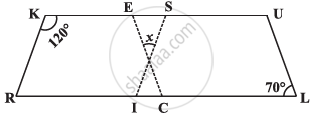
In the above figure both RISK and CLUE are parallelograms. Find the value of x.
In the given figure, `square`ABCD is a parallelogram. Point E is on the ray AB such that BE = AB then prove that line ED bisects seg BC at point F.
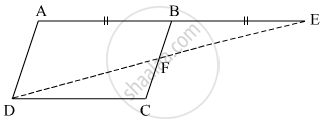
In parallelogram ABCD, X and Y are midpoints of opposite sides AB and DC respectively. Prove that:
(i) AX = YC
(ii) AX is parallel to YC
(iii) AXCY is a parallelogram.
Iron rods a, b, c, d, e, and f are making a design in a bridge as shown in the figure. If a || b, c || d, e || f, find the marked angles between d and f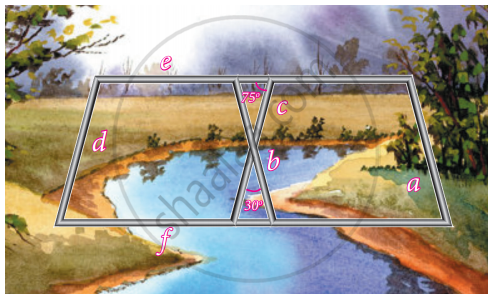
Iron rods a, b, c, d, e, and f are making a design in a bridge as shown in the figure. If a || b, c || d, e || f, find the marked angles between c and f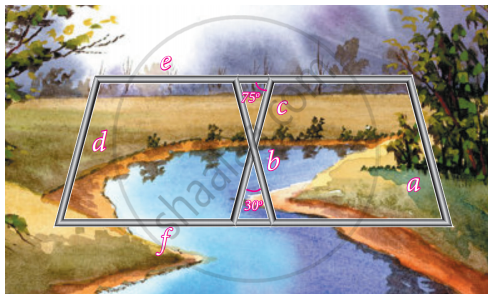
If two adjacent angles of a parallelogram are (5x – 5)° and (10x + 35)°, then the ratio of these angles is ______.
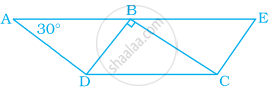
In the given figure, ABCD and BDCE are parallelograms with common base DC. If BC ⊥ BD, then ∠BEC = ______.
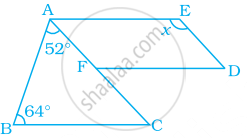
In the following figure, FD || BC || AE and AC || ED. Find the value of x.