Advertisements
Advertisements
प्रश्न
The adjacent sides of a parallelogram are 5 cm and 9 cm. Its perimeter is ______.
Advertisements
उत्तर
The adjacent sides of a parallelogram are 5 cm and 9 cm. Its perimeter is 28 cm.
Explanation:
Perimeter of a parallelogram = 2(Sum of lengths of adjacent sides)
= 2(5 + 9)
= 2 × 14
= 28 cm
APPEARS IN
संबंधित प्रश्न
Consider the given parallelograms. Find the values of the unknowns x, y, z.
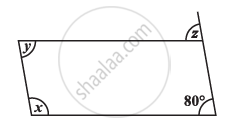
Two adjacent angles of a parallelogram have equal measure. Find the measure of each of the angles of the parallelogram.
The adjacent figure HOPE is a parallelogram. Find the angle measures x, y and z. State the properties you use to find them.
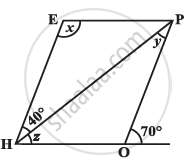
Name the quadrilaterals whose diagonals bisect each other
Ratio of two adjacent sides of a parallelogram is 3 : 4, and its perimeter is 112 cm. Find the length of its each side.
In the following diagram, the bisectors of interior angles of the parallelogram PQRS enclose a quadrilateral ABCD.
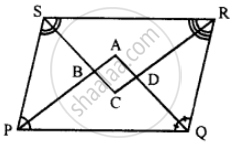
Show that:
(i) ∠PSB + ∠SPB = 90°
(ii) ∠PBS = 90°
(iii) ∠ABC = 90°
(iv) ∠ADC = 90°
(v) ∠A = 90°
(vi) ABCD is a rectangle
Thus, the bisectors of the angles of a parallelogram enclose a rectangle.
Iron rods a, b, c, d, e, and f are making a design in a bridge as shown in the figure. If a || b, c || d, e || f, find the marked angles between b and c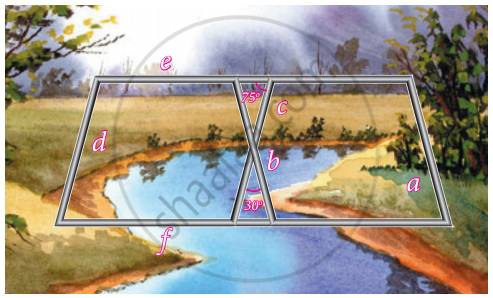
If two adjacent angles of a parallelogram are (5x – 5)° and (10x + 35)°, then the ratio of these angles is ______.
ABCD is a parallelogram. The bisector of angle A intersects CD at X and bisector of angle C intersects AB at Y. Is AXCY a parallelogram? Give reason.
Draw a rough figure of a quadrilateral that is not a parallelogram but has exactly two opposite angles of equal measure.
