Advertisements
Advertisements
प्रश्न
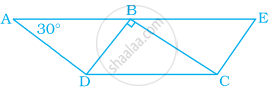
In the given figure, ABCD and BDCE are parallelograms with common base DC. If BC ⊥ BD, then ∠BEC = ______.
पर्याय
60°
30°
150°
120°
Advertisements
उत्तर
In the given figure, ABCD and BDCE are parallelograms with common base DC. If BC ⊥ BD, then ∠BEC = 60°.
Explanation:
Given: ∠BAD = 30°
So, ∠BCD = 30° ...[Opposite angles of a parallelogram are equal]
Now, In triangle CBD:
∠DBC + ∠BCD + ∠CDB = 180° ...[Sum of all angles of a triangle is equal to 180°]
90° + 30° + ∠CDB = 180°
∠CDB = 180° – 90° – 30°
∠CDB = 180° – 120°
∠CDB = 60°
Therefore, ∠BEC = 60° ...[Opposite angles of a parallelogram are equal]
APPEARS IN
संबंधित प्रश्न
The measures of two adjacent angles of a parallelogram are in the ratio 3 : 2. Find the measure of each of the angles of the parallelogram.
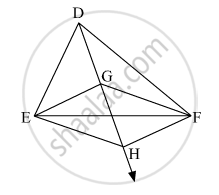
In the given figure, G is the point of concurrence of medians of ΔDEF. Take point H on ray DG such that D-G-H and DG = GH, then prove that `square`GEHF is a parallelogram.
Construct a parallelogram ABCD such that l(BC) = 7 cm, m∠ABC = 40° , l(AB) = 3 cm.
In parallelogram PQRS, ∠Q = (4x – 5)° and ∠S = (3x + 10)°. Calculate: ∠Q and ∠R.
ABCD is a parallelogram. What kind of quadrilateral is it if : AC = BD and AC is perpendicular to BD?
ABCD is a parallelogram. What kind of quadrilateral is it if: AC = BD but AC is not perpendicular to BD?
If opposite angles of a quadrilateral are equal, it must be a parallelogram.
Two angles of a quadrilateral are each of measure 75° and the other two angles are equal. What is the measure of these two angles? Name the possible figures so formed.
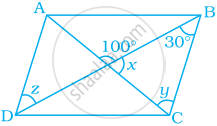
ABCD is a parallelogram. Find the value of x, y and z.
Draw a rough figure of a quadrilateral that is not a parallelogram but has exactly two opposite angles of equal measure.
