Advertisements
Advertisements
प्रश्न
In parallelogram ABCD, the angle bisector of ∠A bisects BC. Will angle bisector of B also bisect AD? Give reason.
Advertisements
उत्तर
Given, ABCD is a parallelogram, bisector of ∠A, bisects BC at F, i.e. ∠1 = ∠2, CF = FB.
Draw FE || BA.
ABFE is a parallelogram by construction ...[∵ FE || BA]
⇒ ∠1 = ∠6 ...[Alternate angle]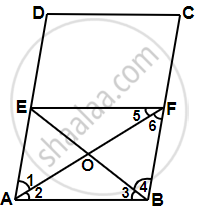
But ∠1 = ∠2 ...[Given]
∴ ∠2 = ∠6
AB = FB [Opposite sides to equal angles are equal] ...(i)
∴ ABFE is a rhombus.
Now, In ΔABO and ΔBOF,
AB = BF ...[From equation (i)]
BO = BO ...[Common]
AO = FO ...[Diagonals of rhombus bisect each other]
∴ ΔABO ≅ ΔBOF ...[By SSS]
∠3 = ∠4 ...[By CPCT]
Now, BF = `1/2` BC ...[Given]
⇒ BF = `1/2` AD ...[BC = AD]
⇒ AE = `1/2` AD ...[BF = AE]
∴ E is the midpoint of AD.
APPEARS IN
संबंधित प्रश्न
Two adjacent angles of a parallelogram have equal measure. Find the measure of each of the angles of the parallelogram.
Perimeter of a parallelogram is 150 cm. One of its sides is greater than the other side by 25 cm. Find the lengths of all sides.
If the ratio of measures of two adjacent angles of a parallelogram is 1 : 2, find the measures of all angles of the parallelogram.
Ratio of consecutive angles of a quadrilateral is 1 : 2 : 3 : 4. Find the measure of its each angle. Write, with reason, what type of a quadrilateral it is.
Construct a parallelogram ABCD such that l(BC) = 7 cm, m∠ABC = 40° , l(AB) = 3 cm.
Prove that the diagonals of a parallelogram bisect each other.
Iron rods a, b, c, d, e, and f are making a design in a bridge as shown in the figure. If a || b, c || d, e || f, find the marked angles between b and c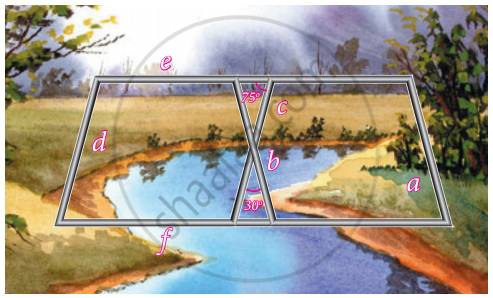
The adjacent sides of a parallelogram are 5 cm and 9 cm. Its perimeter is ______.
ABCD is a parallelogram. The bisector of angle A intersects CD at X and bisector of angle C intersects AB at Y. Is AXCY a parallelogram? Give reason.
Draw a rough figure of a quadrilateral that is not a parallelogram but has exactly two opposite angles of equal measure.
