Advertisements
Advertisements
प्रश्न
Construct a parallelogram HOME with HO = 6 cm, HE = 4 cm and OE = 3 cm.
Advertisements
उत्तर
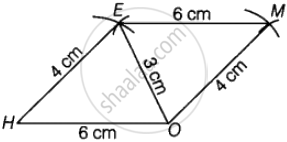
Steps of construction:
Step I: Draw HO = 6 cm.
Step II: With H as centre and radius HE = 4 cm, draw an arc.
Step III: With O as centre and radius OE = 3 cm, draw an arc, intersecting the arc drawn in step II at E.
Step IV: With E as centre and radius EM = 6 cm, draw an arc opposite to the side HE.
Step V: With O as centre and radius OM = 4 cm, draw an arc, intersecting the arc drawn in step IV at M.
Step VI: Join HE, OE, EM and OM.
Hence, HOME is the required parallelogram.
APPEARS IN
संबंधित प्रश्न
Consider the given parallelogram. Find the values of the unknowns x, y, z.
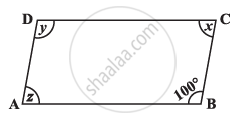
Consider the given parallelograms. Find the values of the unknowns x, y, z.
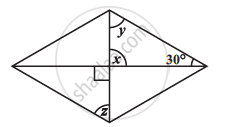
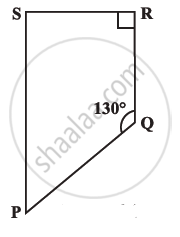
Find the measure of ∠P and ∠S, if `bar(SP) || bar(RQ)` in the following figure. (If you find m∠R, is there more than one method to find m∠P?).
If a triangle and a parallelogram lie on the same base and between the same parallels, then prove that the area of the triangle is equal to half of the area of parallelogram
Iron rods a, b, c, d, e, and f are making a design in a bridge as shown in the figure. If a || b, c || d, e || f, find the marked angles between c and f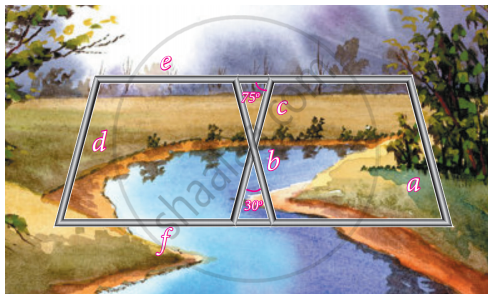
Which of the following figures satisfy the following properties?
- All sides are congruent.
- All angles are right angles.
- Opposite sides are parallel.
In parallelogram MODE, the bisector of ∠M and ∠O meet at Q, find the measure of ∠MQO.
In the following figure of a ship, ABDH and CEFG are two parallelograms. Find the value of x.
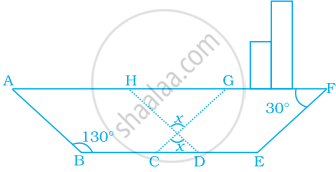
ABCD is a parallelogram. Find the value of x, y and z.
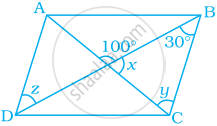
In parallelogram ABCD, the angle bisector of ∠A bisects BC. Will angle bisector of B also bisect AD? Give reason.
