Advertisements
Advertisements
प्रश्न
ABCD is a parallelogram. The bisector of angle A intersects CD at X and bisector of angle C intersects AB at Y. Is AXCY a parallelogram? Give reason.
Advertisements
उत्तर
Given, ABCD is a parallelogram,
So, ∠A = ∠C ...[∵ Opposite angles of a parallelogram are equal]
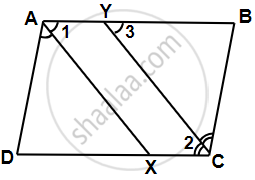
∴ `(∠A)/2 = (∠C)/2` ...[Dividing both the sides by 2]
∠1 = ∠2 ...[Alternative angles]
But ∠2 = ∠3 ...[∵ AB || CD and CY is the transerval]
∴ ∠1 = ∠3
But they are pair of corresponding angles.
∴ AX || YC ...(i)
AY || XC [∵ AB || DC] ...(ii)
From equations (i) and (ii), we get
AXCY is a parallelogram.
APPEARS IN
संबंधित प्रश्न
Consider the given parallelograms. Find the values of the unknowns x, y, z.
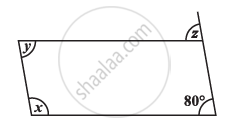
Consider the given parallelograms. Find the values of the unknowns x, y, z.
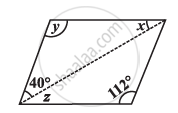
Can a quadrilateral ABCD be a parallelogram if ∠D + ∠B = 180°?
If the ratio of measures of two adjacent angles of a parallelogram is 1 : 2, find the measures of all angles of the parallelogram.
ABCD is a parallelogram. What kind of quadrilateral is it if: AC = BD but AC is not perpendicular to BD?
Prove that the diagonals of a parallelogram bisect each other.
In the given figure, AB || EC, AB = AC and AE bisects ∠DAC. Prove that:
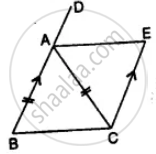
- ∠EAC = ∠ACB
- ABCE is a parallelogram.
Which of the following is a property of a parallelogram?
If two adjacent angles of a parallelogram are (5x – 5)° and (10x + 35)°, then the ratio of these angles is ______.
Construct a parallelogram when one of its side is 4 cm and its two diagonals are 5.6 cm and 7 cm. Measure the other side.
