Advertisements
Advertisements
Question
ABCD is a parallelogram. The bisector of angle A intersects CD at X and bisector of angle C intersects AB at Y. Is AXCY a parallelogram? Give reason.
Advertisements
Solution
Given, ABCD is a parallelogram,
So, ∠A = ∠C ...[∵ Opposite angles of a parallelogram are equal]
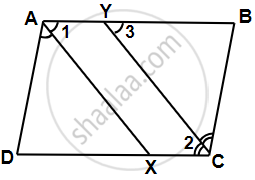
∴ `(∠A)/2 = (∠C)/2` ...[Dividing both the sides by 2]
∠1 = ∠2 ...[Alternative angles]
But ∠2 = ∠3 ...[∵ AB || CD and CY is the transerval]
∴ ∠1 = ∠3
But they are pair of corresponding angles.
∴ AX || YC ...(i)
AY || XC [∵ AB || DC] ...(ii)
From equations (i) and (ii), we get
AXCY is a parallelogram.
APPEARS IN
RELATED QUESTIONS
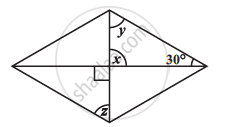
Consider the given parallelograms. Find the values of the unknowns x, y, z.
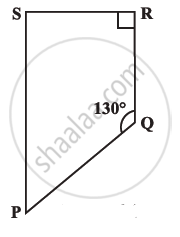
Find the measure of ∠P and ∠S, if `bar(SP) || bar(RQ)` in the following figure. (If you find m∠R, is there more than one method to find m∠P?).
Referring the adjacent figure of a parallelogram, write the answer of questions given below.
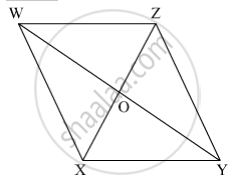
(1) If l(WZ) = 4.5 cm then l(XY) = ?
(2) If l(YZ) = 8.2 cm then l(XW) = ?
(3) If l(OX) = 2.5 cm then l(OZ) = ?
(4) If l(WO) = 3.3 cm then l(WY) = ?
(5) If m∠WZY = 120° then m∠WXY = ? and m∠XWZ = ?
In parallelogram ABCD, ∠A = 3 times ∠B. Find all the angles of the parallelogram. In the same parallelogram, if AB = 5x – 7 and CD = 3x +1 ; find the length of CD.
ABCD is a parallelogram. What kind of quadrilateral is it if : AC = BD and AC is perpendicular to BD?
The adjacent sides of a parallelogram are 5 cm and 9 cm. Its perimeter is ______.
Two angles of a quadrilateral are each of measure 75° and the other two angles are equal. What is the measure of these two angles? Name the possible figures so formed.
The angle between the two altitudes of a parallelogram through the vertex of an obtuse angle of the parallelogram is 45°. Find the angles of the parallelogram.
Construct a parallelogram ABCD in which AB = 4 cm, BC = 5 cm and ∠B = 60°.
Construct a parallelogram HOME with HO = 6 cm, HE = 4 cm and OE = 3 cm.
