Advertisements
Advertisements
Question
In the given figure, AB || EC, AB = AC and AE bisects ∠DAC. Prove that:
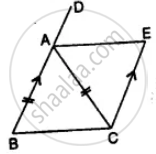
- ∠EAC = ∠ACB
- ABCE is a parallelogram.
Advertisements
Solution
ABCE is a quadrilateral in which AC is its diagonal and AB || EC, AB = AC
BA is produced to D
AE bisects ∠DAC
To prove:
(i) ∠EAC = ∠ACB
(ii) ABCE is a parallelogram
Proof:
(i) In ∆ABC and ∆AEC
AC = AC (common)
AB || CE (given)
∠BAC = ∠ACE (Alternate angle)
∆ABC = ∆AEC (SAS Axiom)
(ii) ∠BCA = ∠CAE (c.p.c.t.)
But these are alternate angles
AE || BC
But AB || EC (given)
∴ ABCE is a parallelogram
APPEARS IN
RELATED QUESTIONS
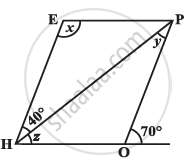
The adjacent figure HOPE is a parallelogram. Find the angle measures x, y and z. State the properties you use to find them.
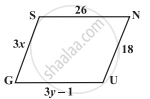
The following figure GUNS is a parallelogram. Find x and y. (Lengths are in cm)
Perimeter of a parallelogram is 150 cm. One of its sides is greater than the other side by 25 cm. Find the lengths of all sides.
PQRS is a parallelogram whose diagonals intersect at M.
If ∠PMS = 54°, ∠QSR = 25° and ∠SQR = 30° ; find :
(i) ∠RPS
(ii) ∠PRS
(iii) ∠PSR.
ABCD is a parallelogram. What kind of quadrilateral is it if: AC = BD but AC is not perpendicular to BD?
In the following diagram, the bisectors of interior angles of the parallelogram PQRS enclose a quadrilateral ABCD.
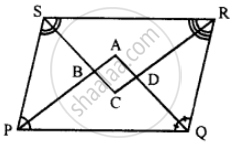
Show that:
(i) ∠PSB + ∠SPB = 90°
(ii) ∠PBS = 90°
(iii) ∠ABC = 90°
(iv) ∠ADC = 90°
(v) ∠A = 90°
(vi) ABCD is a rectangle
Thus, the bisectors of the angles of a parallelogram enclose a rectangle.
In parallelogram PQRS, O is the mid point of SQ. Find ∠S, ∠R, PQ, QR and diagonal PR.

Two angles of a quadrilateral are each of measure 75° and the other two angles are equal. What is the measure of these two angles? Name the possible figures so formed.
ABCD is a parallelogram. The bisector of angle A intersects CD at X and bisector of angle C intersects AB at Y. Is AXCY a parallelogram? Give reason.
Draw a rough figure of a quadrilateral that is not a parallelogram but has exactly two opposite angles of equal measure.
