Advertisements
Advertisements
प्रश्न
The angle between the two altitudes of a parallelogram through the vertex of an obtuse angle of the parallelogram is 45°. Find the angles of the parallelogram.
Advertisements
उत्तर
Let ABCD be a parallelogram, where BE and BF are the perpendiculars through the vertex B to the sides DC and AD, respectively.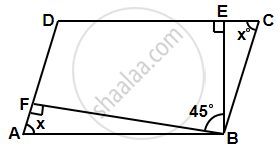
Let ∠A = ∠C = x, ∠B = ∠D = y ...[Opposite angles are equal in parallelogram]
Now, ∠A + ∠B = 180° ...[Adjacent sides of a parallelogram are supplementary]
In triangle ABF;
∠ABF = 90° – x
And in triangle BEC,
∠EBC = 90° – x
So, x + 90° – x + 45° + 90° – x = 180°
⇒ – x = 180° – 225°
⇒ x = 45°
So, ∠A = ∠C = 45°
∠B = 45° + 45° + 45° = 135°
⇒ ∠D = 135°
Hence, the angles are 45°, 135°, 45° and 135°.
APPEARS IN
संबंधित प्रश्न
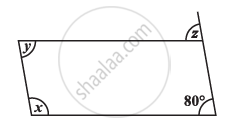
Consider the given parallelograms. Find the values of the unknowns x, y, z.
If the ratio of measures of two adjacent angles of a parallelogram is 1 : 2, find the measures of all angles of the parallelogram.
In parallelogram PQRS, ∠Q = (4x – 5)° and ∠S = (3x + 10)°. Calculate: ∠Q and ∠R.
Prove that the diagonals of a parallelogram bisect each other.
If a triangle and a parallelogram lie on the same base and between the same parallels, then prove that the area of the triangle is equal to half of the area of parallelogram
Iron rods a, b, c, d, e, and f are making a design in a bridge as shown in the figure. If a || b, c || d, e || f, find the marked angles between d and f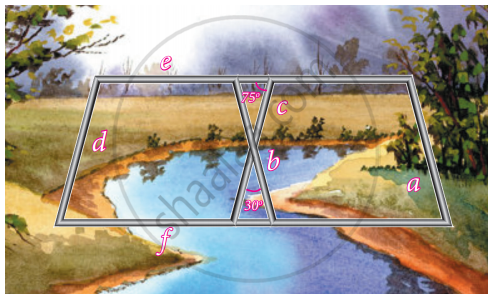
In parallelogram MODE, the bisector of ∠M and ∠O meet at Q, find the measure of ∠MQO.
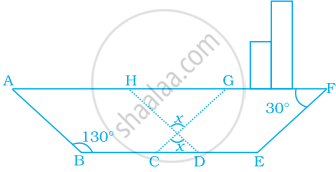
In the following figure of a ship, ABDH and CEFG are two parallelograms. Find the value of x.
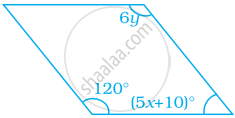
Find the values of x and y in the following parallelogram.
In the following figure, FD || BC || AE and AC || ED. Find the value of x.