Advertisements
Advertisements
प्रश्न
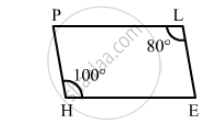
Can the following figure be parallelogram. Justify your answer.
Advertisements
उत्तर
\[\text{ No . This is because the opposite angles are not equal } . \]
संबंधित प्रश्न
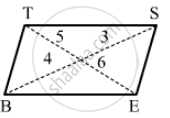
Can the following figure be parallelogram. Justify your answer.
In the following Figure ABCD is a arallelogram, CE bisects ∠C and AF bisects ∠A. In each of the following, if the statement is true, give a reason for the same:
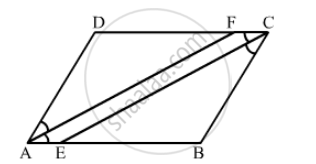
(i) ∠A = ∠C
(ii) \[\angle FAB = \frac{1}{2}\angle A\]
(iii) \[\angle DCE = \frac{1}{2}\angle C\]
(iv) \[\angle CEB = \angle FAB\]
(v) CE || AF
Fill in the blank, in each of the following, so as to make the statement true:
If the diagonals of a parallelogram bisect each other at right angles, then it is a ......
The diagonals of a quadrilateral are perpendicular to each other. Is such a quadrilateral always a rhombus? If your answer is 'No', draw a figure to justify your answer.
Draw a rhombus, having each side of length 3.5 cm and one of the angles as 40°.
Identify all the quadrilateral that have Four sides of equal length
Draw a rhombus KLMN such that its side is 4 cm and m∠K = 75°.
A quadrilateral whose all sides are equal, opposite angles are equal and the diagonals bisect each other at right angles is a ______.
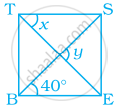
In the figure, BEST is a rhombus, Then the value of y – x is ______.
Construct a rhombus whose side is 5 cm and one angle is of 60°.
