Advertisements
Advertisements
प्रश्न
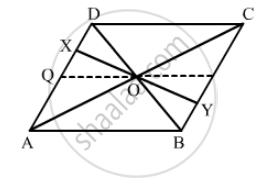
Diagonals of parallelogram ABCD intersect at O as shown in the following fegure. XY contains O, and X, Y are points on opposite sides of the parallelogram. Give reasons for each of the following:
(i) OB = OD
(ii) ∠OBY = ∠ODX
(iii) ∠BOY = ∠DOX
(iv) ∆BOY ≅ ∆DOX
Now, state if XY is bisected at O.
Advertisements
उत्तर
(i) Diagonals of a parallelogram bisect each other.
(ii) Alternate angles
(iii) Vertically opposite angles
(iv)\[\text{ In } ∆ BOY \text{ and } ∆ DOX: \]
\[OB = OD (\text{ diagonals of a parallelogram bisect each other })\]
\[\angle OBY = \angle ODX (alternate angles)\]
\[\angle BOY = \angle DOX (\text{ vertically opposite angles })\]
ASA congruence:
XO = YO (c.p.c.t)
So, XY is bisected at O.
संबंधित प्रश्न
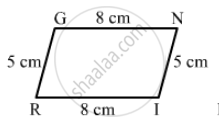
Can the following figure be parallelogram. Justify your answer.
The measure of one angle of a parallelogram is 70°. What are the measures of the remaining angles?
Which of the following statement is true for a rhombus?
It has two pairs of parallel sides.
The diagonals of a parallelogram are not perpendicular. Is it a rhombus? Why or why not?
Construct a rhombus whose diagonals are of length 10 cm and 6 cm.
State with reason whether the following statement is ‘true’ or ‘false’.
Every parallelogram is a rhombus.
Diagonals PR and QS of a rhombus PQRS are 20 cm and 48 cm respectively. Find the length of side PQ.
Measure of one angle of a rhombus is 50°, find the measures of remaining three angles.
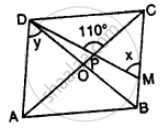
The given figure shows a rhombus ABCD in which angle BCD = 80°. Find angles x and y.
If the diagonal of a rhombus are equal, then the rhombus is a
