Advertisements
Advertisements
प्रश्न
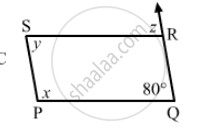
The following figure is parallelogram. Find the degree values of the unknown x, y, z.
Advertisements
उत्तर
\[\text{ Opposite angles are equal in a parallelogram } . \]
\[ \therefore y = 80°\]
\[y + x = 180° \]
\[x = 180° - 100°= 80°\]
\[z = y = 80° (\text{ alternate angles })\]
संबंधित प्रश्न
In a parallelogram ABCD, ∠D = 135°, determine the measure of ∠A and ∠B.
In the following Figure ABCD is a arallelogram, CE bisects ∠C and AF bisects ∠A. In each of the following, if the statement is true, give a reason for the same:
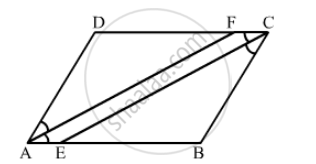
(i) ∠A = ∠C
(ii) \[\angle FAB = \frac{1}{2}\angle A\]
(iii) \[\angle DCE = \frac{1}{2}\angle C\]
(iv) \[\angle CEB = \angle FAB\]
(v) CE || AF
Which of the following statement is true for a rhombus?
Two of its angles are at right angles
Fill in the blank, in each of the following, so as to make the statement true:
If the diagonals of a parallelogram bisect each other at right angles, then it is a ......
ABCD is a rhombus. If ∠ACB = 40°, find ∠ADB.
State with reason whether the following statement is ‘true’ or ‘false’.
Every parallelogram is a rhombus.
If opposite angles of a rhombus are (2x)° and (3x - 40)° then value of x is ______.
If a diagonal of a quadrilateral bisects both the angles, then it is a ______.
If all sides of a quadrilateral are equal, it is a ______.
A rhombus is a parallelogram in which ______ sides are equal.
