Advertisements
Advertisements
प्रश्न
If a diagonal of a quadrilateral bisects both the angles, then it is a ______.
विकल्प
kite
parallelogram
rhombus
rectangle
Advertisements
उत्तर
If a diagonal of a quadrilateral bisects both the angles, then it is a rhombus.
Explanation:
A parallelogram is a quadrilateral whose diagonal bisects both angles. It is also true for rhombus and rectangle but in a rhombus all the sides are also equal and in a rectangle all the angles are also equal.
APPEARS IN
संबंधित प्रश्न
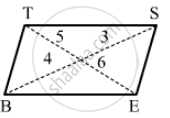
Can the following figure be parallelogram. Justify your answer.
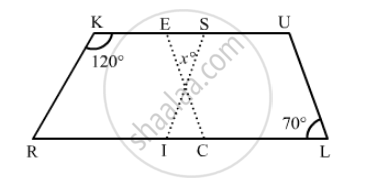
In the following figure RISK and CLUE are parallelograms. Find the measure of x.
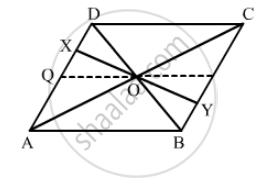
Diagonals of parallelogram ABCD intersect at O as shown in the following fegure. XY contains O, and X, Y are points on opposite sides of the parallelogram. Give reasons for each of the following:
(i) OB = OD
(ii) ∠OBY = ∠ODX
(iii) ∠BOY = ∠DOX
(iv) ∆BOY ≅ ∆DOX
Now, state if XY is bisected at O.
In a parallelogram ABCD, AB = 10 cm, AD = 6 cm. The bisector of ∠A meets DC in E, AEand BC produced meet at F. Find te length CF.
Fill in the blank, inthe following, so as to make the statement true:
A square is a rhombus in which .....
Fill in the blank, in each of the following, so as to make the statement true:
If the diagonals of a parallelogram bisect each other at right angles, then it is a ......
Diagonals of a rhombus are 20 cm and 21 cm respectively, then find the side of rhombus and its perimeter.
Draw a rhombus KLMN such that its side is 4 cm and m∠K = 75°.
ABCD is a rhombus such that the perpendicular bisector of AB passes through D. Find the angles of the rhombus.
Hint: Join BD. Then ∆ABD is equilateral.
Construct a rhombus whose side is 5 cm and one angle is of 60°.
