Advertisements
Advertisements
प्रश्न
The measure of one angle of a parallelogram is 70°. What are the measures of the remaining angles?
Advertisements
उत्तर
\[\text{ Given that one angle of the parallelogram is } 70° . \]
\[\text{ Since opposite angles have same value, if one is }70° , \text{ then the one directly opposite will also be } 70° . \]
\[\text{ So, let one angle be }x° . \]
\[x° + 70° = 180° (\text{ the sum of adjacent angles of a parallelogram is } 180° )\]
\[x° = 180° - 70° \]
\[x° = 110° \]
\[\text{ Thus, the remaining angles are }110° , 110° \text{ and }70° . \]
संबंधित प्रश्न
The following figure is parallelogram. Find the degree values of the unknowns x, y, z.
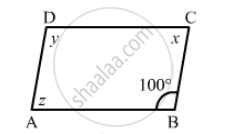
Two opposite angles of a parallelogram are (3x − 2)° and (50 − x)°. Find the measure of each angle of the parallelogram.
In a parallelogram ABCD, ∠D = 135°, determine the measure of ∠A and ∠B.
The sum of two opposite angles of a parallelogram is 130°. Find all the angles of the parallelogram.
Which of the following statement is true for a rhombus?
It is a quadrilateral.
Fill in the blank, in the following, so as to make the statement true:
The diagonals of a rhombus ...... each other at ...... angles.
One side of a rhombus is of length 4 cm and the length of an altitude is 3.2 cm. Draw the rhombus.
Diagonals of a rhombus are 20 cm and 21 cm respectively, then find the side of rhombus and its perimeter.
State with reason whether the following statement is ‘true’ or ‘false’.
Every parallelogram is a rhombus.
Draw a rhombus KLMN such that its side is 4 cm and m∠K = 75°.
