Advertisements
Advertisements
Question
A quadrilateral whose opposite sides and all the angles are equal is a ______.
Options
rectangle
parallelogram
square
rhombus
Advertisements
Solution
A quadrilateral whose opposite sides and all the angles are equal is a rectangle.
Explanation:
We know that, in a rectangle, opposite sides and all the angles are equal.
APPEARS IN
RELATED QUESTIONS
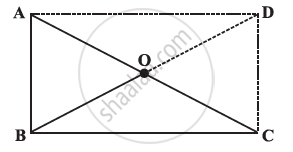
ABC is a right-angled triangle and O is the mid point of the side opposite to the right angle. Explain why O is equidistant from A, B and C. (The dotted lines are drawn additionally to help you)
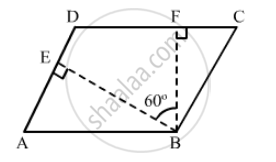
The angle between the altitudes of a parallelogram, through the same vertex of an obtuse angle of the parallelogram is 60°. Find the angles of the parallelogram.
Which of the following statement is true for a rectangle?
It has two pairs of equal sides.
Which of the following statement is true for a rectangle?
Its diagonals are perpendicular.
Which of the following statement true for a square?
Its diagonals bisect each other at right angle.
Diagonals of a rectangle ABCD intersect at point O. If AC = 8 cm then find BO and if ∠CAD =35° then find ∠ACB.
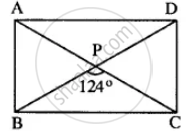
ABCD is a rectangle, if ∠BPC = 124°
Calculate:
- ∠BAP
- ∠ADP
Every rectangle is a trapezium.
In a rectangle ABCD, AB = 25 cm and BC = 15. In what ratio does the bisector of ∠C divide AB?
In rectangle READ, find ∠EAR, ∠RAD and ∠ROD

