Advertisements
Advertisements
Question
Which of the following statement true for a square?
Its diagonals bisect each other at right angle.
Advertisements
Solution
True
RELATED QUESTIONS
Explain why a rectangle is a convex quadrilateral.
Diagonals of a parallelogram ABCD intersect at O. AL and CM are drawn perpendiculars to BD such that L and M lie on BD. Is AL = CM? Why or why not?
Which of the following statement is true for a rectangle?
It has all its sides of equal length.
Which of the following statement is true for a rectangle?
Its diagonals are equal.
Which of the following statement is true for a rectangle?
Its diagonals are perpendicular.
Which of the following statement true for a square?
Its diagonals are equal to its sides.
A mason has made a concrete slab. He needs it to be rectangular. In what different ways can he make sure that it is rectangular?
State with reason whether the following statement is ‘true’ or ‘false’.
Every parallelogram is a rectangle.
All squares are rectangles.
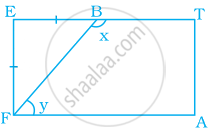
A playground is in the form of a rectangle ATEF. Two players are standing at the points F and B where EF = EB. Find the values of x and y.