Advertisements
Advertisements
प्रश्न
Draw a rectangle ABCD such that l(AB) = 6.0 cm and l (BC) = 4.5 cm.
Advertisements
उत्तर
Steps of Construction:
Step 1: Draw AB = 6 cm.
Step 2: Draw ∠ABX = 90º.
Step 3: With B as centre and radius 4.5 cm, draw an arc cutting the ray BX at C.
Step 4: With C as centre and radius 6 cm, draw an arc.
Step 5: With A as centre and radius 4.5 cm, draw an arc cutting the previous arc at D.
Step 6: Join AD and CD.
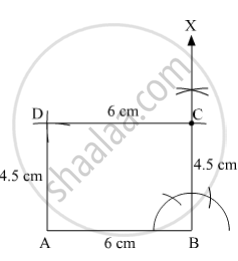
Here, ABCD is the required rectangle.
संबंधित प्रश्न
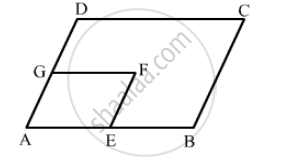
In the following figure, ABCD and AEFG are parallelograms. If ∠C = 55°, what is the measure of ∠F?
Which of the following statement is true for a rectangle?
Its diagonals are perpendicular.
Which of the following statement is true for a rectangle?
Its diagonals are equal and perpendicular, and bisect each other.
Which of the following statement is true for a rectangle?
All rectangles are squares.
The sides of a rectangle are in the ratio 4 : 5. Find its sides if the perimeter is 90 cm.
Using opposite angles test for parallelogram, prove that every rectangle is a parallelogram.
Diagonals of a rectangle PQRS are intersecting in point M. If ∠QMR = 50° find the measure of ∠MPS.
Every trapezium is a rectangle.
PQRS is a rectangle. The perpendicular ST from S on PR divides ∠S in the ratio 2:3. Find ∠TPQ.
In rectangle READ, find ∠EAR, ∠RAD and ∠ROD

