Advertisements
Advertisements
प्रश्न
In a rectangle ABCD, prove that ∆ACB ≅ ∆CAD.
Advertisements
उत्तर

In ∆ACB and ∆CAD:
AB = CD (rectangle property)
AD = BC (rectangle property)
AC ( common side )
Hence, by SSS criterion, it is proved that\[∆ ACB \cong ∆ CAD\]
संबंधित प्रश्न
Explain why a rectangle is a convex quadrilateral.
In a parallelogram ABCD, the diagonals bisect each other at O. If ∠ABC = 30°, ∠BDC = 10° and ∠CAB = 70°. Find:
∠DAB, ∠ADC, ∠BCD, ∠AOD, ∠DOC, ∠BOC, ∠AOB, ∠ACD, ∠CAB, ∠ADB, ∠ACB, ∠DBC and ∠DBA.
Diagonals of a parallelogram ABCD intersect at O. AL and CM are drawn perpendiculars to BD such that L and M lie on BD. Is AL = CM? Why or why not?
Which of the following statement is true for a rectangle?
Its diagonals are perpendicular.
Which of the following statement true for a square?
Its diagonals bisect each other at right angle.
Using opposite angles test for parallelogram, prove that every rectangle is a parallelogram.
A parallelogram PQRS is constructed with sides QR = 6 cm, PQ = 4 cm and ∠PQR = 90°. Then PQRS is a ______.
Every rectangle is a trapezium.
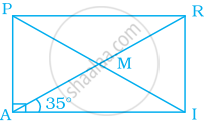
In rectangle PAIR, find ∠ARI, ∠RMI and ∠PMA.
A rectangular MORE is shown below:

Answer the following questions by giving appropriate reason.
- Is RE = OM?
- Is ∠MYO = ∠RXE?
- Is ∠MOY = ∠REX?
- Is ΔMYO ≅ ΔRXE?
- Is MY = RX?
