Advertisements
Advertisements
प्रश्न
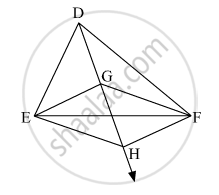
In the given figure, G is the point of concurrence of medians of ΔDEF. Take point H on ray DG such that D-G-H and DG = GH, then prove that `square`GEHF is a parallelogram.
Advertisements
उत्तर
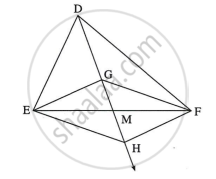
Let, the median side drawn from point D intersects EF at point M.
Point G is the concurrence point.
The concurrence point divides each median in the ratio 2:1.
∴ DG : GM = 2 : 1
∴ `("DG")/("GM") = 2/1`
∴ DG = 2GM ...(i)
∴ DG = GM + MH ...(G-M-H)
∴ 2GM = GM + MH ...[from (i)]
∴ 2GM – GM = MH
∴ GM = MH ...(ii)
In `square`GEHF,
Line GM ≅ Line MH ...[From (ii)]
Line EM ≅ Line MF ...(Point M is the midpoint of line EF)
A quadrilateral is a parallelogram if its diagonals bisect each other.
`square`GEHF is a parallelogram.
APPEARS IN
संबंधित प्रश्न
Consider the given parallelogram. Find the values of the unknowns x, y, z.
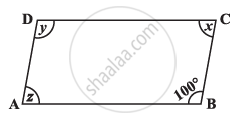
Consider the given parallelogram. Find the values of the unknowns x, y, z.
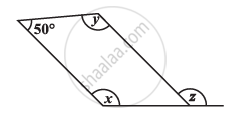
Consider the given parallelograms. Find the values of the unknowns x, y, z.
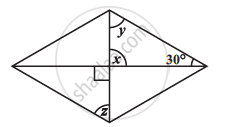
Consider the given parallelograms. Find the values of the unknowns x, y, z.
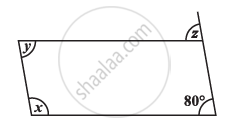
Can a quadrilateral ABCD be a parallelogram if ∠A = 70° and ∠C = 65°?
Two adjacent angles of a parallelogram have equal measure. Find the measure of each of the angles of the parallelogram.
If the ratio of measures of two adjacent angles of a parallelogram is 1 : 2, find the measures of all angles of the parallelogram.
Prove that the diagonals of a parallelogram bisect each other.
Use the information given in the alongside diagram to find the value of x, y, and z.
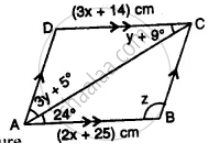
If a triangle and a parallelogram lie on the same base and between the same parallels, then prove that the area of the triangle is equal to half of the area of parallelogram
Iron rods a, b, c, d, e, and f are making a design in a bridge as shown in the figure. If a || b, c || d, e || f, find the marked angles between c and f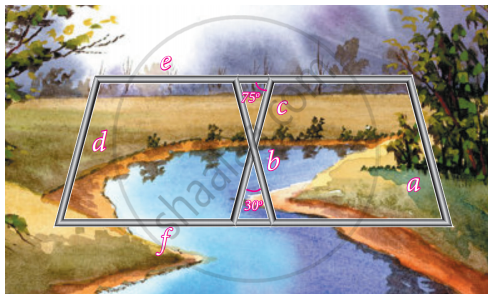
Which of the following is a property of a parallelogram?
If opposite angles of a quadrilateral are equal, it must be a parallelogram.
ABCD is a parallelogram. The bisector of angle A intersects CD at X and bisector of angle C intersects AB at Y. Is AXCY a parallelogram? Give reason.
A diagonal of a parallelogram bisects an angle. Will it also bisect the other angle? Give reason.
The angle between the two altitudes of a parallelogram through the vertex of an obtuse angle of the parallelogram is 45°. Find the angles of the parallelogram.
Construct a parallelogram ABCD in which AB = 4 cm, BC = 5 cm and ∠B = 60°.
Construct a parallelogram when one of its side is 4 cm and its two diagonals are 5.6 cm and 7 cm. Measure the other side.
