Advertisements
Advertisements
प्रश्न
Given a parallelogram ABCD. Complete each statement along with the definition or property used.
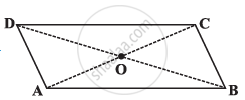
- AD = ______
- ∠DCB = ______
- OC = ______
- m∠DAB + m∠CDA = ______
Advertisements
उत्तर
- In a parallelogram, opposite sides are equal in length.
AD = BC - In a parallelogram, opposite angles are equal in measure.
∠DCB = ∠DAB - In a parallelogram, diagonals bisect each other.
Hence, OC = OA - In a parallelogram, adjacent angles are supplementary to each other.
Hence, m∠DAB + m∠CDA =180°
संबंधित प्रश्न
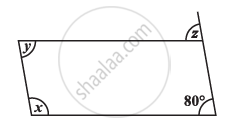
Consider the given parallelograms. Find the values of the unknowns x, y, z.
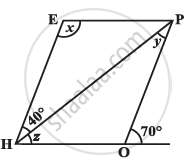
The adjacent figure HOPE is a parallelogram. Find the angle measures x, y and z. State the properties you use to find them.
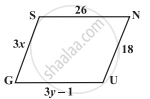
The following figure GUNS is a parallelogram. Find x and y. (Lengths are in cm)
Perimeter of a parallelogram is 150 cm. One of its sides is greater than the other side by 25 cm. Find the lengths of all sides.
In the adjacent figure, if seg AB || seg PQ, seg AB ≅ seg PQ, seg AC || seg PR, seg AC ≅ seg PR then prove that, seg BC || seg QR and seg BC ≅ seg QR.
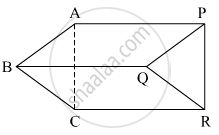
Referring the adjacent figure of a parallelogram, write the answer of questions given below.
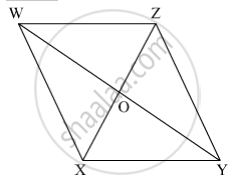
(1) If l(WZ) = 4.5 cm then l(XY) = ?
(2) If l(YZ) = 8.2 cm then l(XW) = ?
(3) If l(OX) = 2.5 cm then l(OZ) = ?
(4) If l(WO) = 3.3 cm then l(WY) = ?
(5) If m∠WZY = 120° then m∠WXY = ? and m∠XWZ = ?
Prove that the diagonals of a parallelogram bisect each other.
In the following diagram, the bisectors of interior angles of the parallelogram PQRS enclose a quadrilateral ABCD.
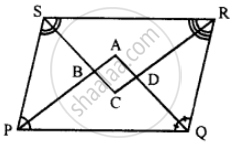
Show that:
(i) ∠PSB + ∠SPB = 90°
(ii) ∠PBS = 90°
(iii) ∠ABC = 90°
(iv) ∠ADC = 90°
(v) ∠A = 90°
(vi) ABCD is a rectangle
Thus, the bisectors of the angles of a parallelogram enclose a rectangle.
All rectangles are parallelograms.
Construct a parallelogram HOME with HO = 6 cm, HE = 4 cm and OE = 3 cm.
