Advertisements
Advertisements
प्रश्न
Prove that quadrilateral formed by the intersection of angle bisectors of all angles of a parallelogram is a rectangle.

Advertisements
उत्तर
Given: `square`ABCD is a parallelogram.
To prove: `square`PQRS is a rectangle.
Proof:
`square`ABCD is a parallelogram. ...(Given)
∠ADC + ∠BCD = 180° ...(Adjacent angles of a parallelogram are supplementary.)
Multiplying each side by `1/2`,
`1/2` ∠ADC + `1/2` ∠BCD = `1/2xx180°` ...(i)
But,
`1/2` ∠ADC = ∠PDC ...(Ray DP bisects ∠ADC) ...(ii)
And `1/2` ∠BCD = ∠PCD ...(Ray CP bisects ∠BCD) ...(iii)
∴ ∠PDC + ∠PCD = 90° ...[From (i), (ii) and (iii)] ...(iv)
In ΔPDC,
∠PDC + ∠PCD + ∠DPC = 180° ...(The sum of the measures of the three angles of a triangle is 180°.)
∴ 90° + ∠DPC = 180° ...[from (iv)]
∴ ∠DPC = 180° – 90°
∴ ∠DPC = 90°
That means ∠SPQ = 90° ...(D-S-P, P-Q-C) ...(v)
Similarly, we can prove that, ∠SRQ = 90° ...(vi)
Similarly, ∠ASD = 90° and ∠BQC = 90° ...(vii)
∠PSR = ∠ASD ...(vertex angle)
∴ ∠PSR = 90° ...[From (vii)] ...(viii)
Similarly, ∠PQR = 90° ...(ix)
In `square`PQRS,
∠SPQ = ∠SRQ = ∠PSR = ∠PQR = 90° ...[From (v), (vi), (viii) and (ix)]
∴ `square`PQRS is a rectangle.
APPEARS IN
संबंधित प्रश्न
Name the quadrilaterals whose diagonals are equal
The shorter side of a parallelogram is 4.8 cm and the longer side is half as much again as the shorter side. Find the perimeter of the parallelogram.
In a parallelogram ABCD, the diagonals bisect each other at O. If ∠ABC = 30°, ∠BDC = 10° and ∠CAB = 70°. Find:
∠DAB, ∠ADC, ∠BCD, ∠AOD, ∠DOC, ∠BOC, ∠AOB, ∠ACD, ∠CAB, ∠ADB, ∠ACB, ∠DBC and ∠DBA.
In the following figure, ABCD and AEFG are parallelograms. If ∠C = 55°, what is the measure of ∠F?
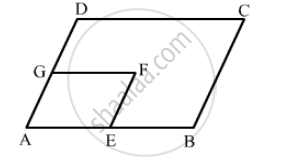
In Fig. 17.29, suppose it is known that DE = DF. Then, is ΔABC isosceles? Why or why not?
Which of the following statement is true for a rectangle?
Its diagonals are equal and perpendicular, and bisect each other.
Which of the following statement is true for a rectangle?
All rectangles are squares.
Find the length of the diagonal of a rectangle whose sides are 12 cm and 5 cm.
Draw a square whose each side measures 4.8 cm.
State with Reason Whether the Following Statement is ‘True’ Or ‘False’.
Every rectangle is a parallelogram.
State with reason whether the following statement is ‘true’ or ‘false’.
Every parallelogram is a rectangle.
The following figure is a rectangle in which x: y = 3: 7; find the values of x and y.
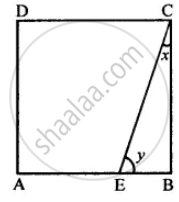
If the adjacent angles of a parallelogram are equal, then the parallelogram is a ______.
If diagonals of a quadrilateral are equal, it must be a rectangle.
Every rectangle is a trapezium.
In a rectangle ABCD, AB = 25 cm and BC = 15. In what ratio does the bisector of ∠C divide AB?
A rectangular MORE is shown below:

Answer the following questions by giving appropriate reason.
- Is RE = OM?
- Is ∠MYO = ∠RXE?
- Is ∠MOY = ∠REX?
- Is ΔMYO ≅ ΔRXE?
- Is MY = RX?
Construct a rectangle whose one side is 3 cm and a diagonal equal to 5 cm.
