Advertisements
Advertisements
प्रश्न
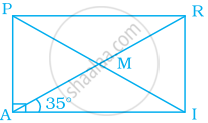
In rectangle PAIR, find ∠ARI, ∠RMI and ∠PMA.
Advertisements
उत्तर
In ΔARI,
∠RAI + ∠AIR + ∠IRA = 180° ...[Angle sum property]
`\implies` 35° + 90° + ∠IRA = 180°
`\implies` ∠IRA = 180° – 125° = 55°
∴ ∠ARI = 55° ...(i)
Now, in ΔRMI,
Since, the diagonals of a rectangle are equal and they bisect each other
∴ MI = MR
`\implies` ∠MRI = ∠MIR = 55° ...[From (i)]
And ∠RMI + ∠MIR + ∠IRM = 180° ...[By angle sum property]
`\implies` ∠RMI + 55° + 55° = 180°
`\implies` ∠RMI = 180° – 110° = 70°
Now, ∠RMI = ∠PMA = 70° ...[∵ Vertically opposite angles]
Hence, ∠ARI = 55°, ∠RMI = 70° and ∠PMA = 70°
APPEARS IN
संबंधित प्रश्न
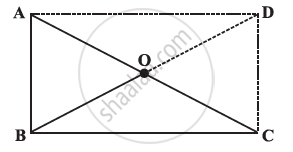
ABC is a right-angled triangle and O is the mid point of the side opposite to the right angle. Explain why O is equidistant from A, B and C. (The dotted lines are drawn additionally to help you)
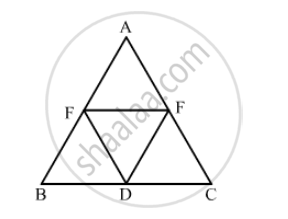
In the following figure, BDEF and DCEF are each a parallelogram. Is it true that BD = DC? Why or why not?
Which of the following statement is true for a rectangle?
Its diagonals are equal.
Which of the following statement true for a square?
Its diagonals are equal to its sides.
The sides of a rectangle are in the ratio 2 : 3, and its perimeter is 20 cm. Draw the rectangle.
Find the length of the diagonal of a rectangle whose sides are 12 cm and 5 cm.
Diagonals of a rectangle PQRS are intersecting in point M. If ∠QMR = 50° find the measure of ∠MPS.
Show that the bisectors of angles of a parallelogram form a rectangle
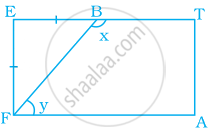
A playground is in the form of a rectangle ATEF. Two players are standing at the points F and B where EF = EB. Find the values of x and y.
Construct a rectangle whose one side is 3 cm and a diagonal equal to 5 cm.
